
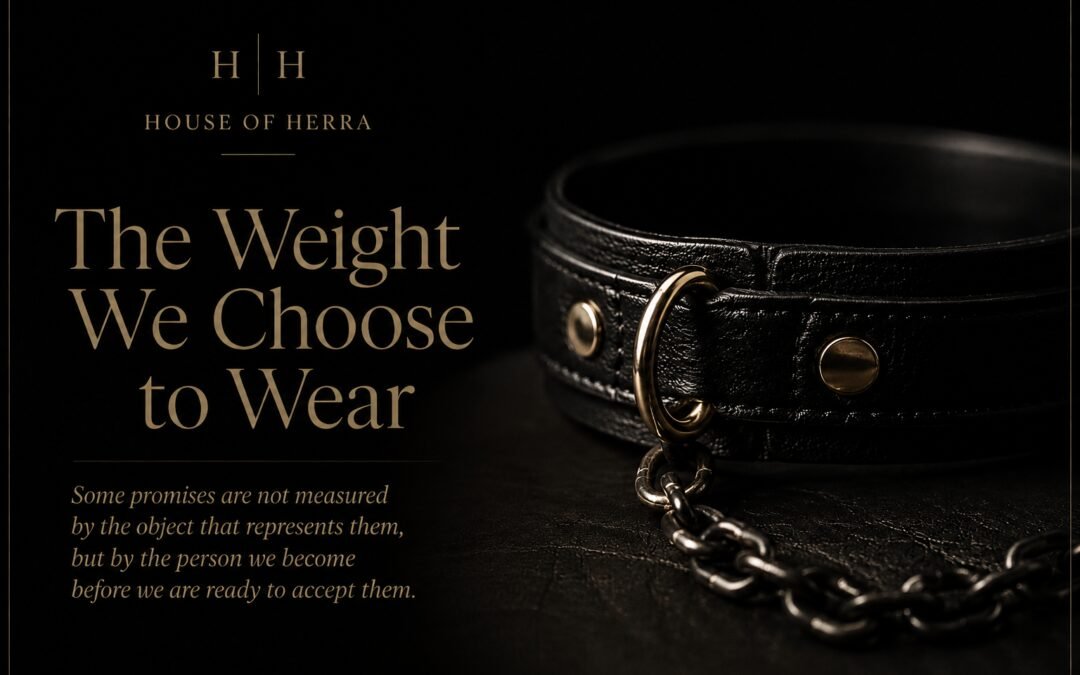
Some promises are not measured by the object that represents them, but by the person we become before we are ready to accept them.
There was a time when I thought a collar was something that marked the beginning of submission.
I understand now that it more often marks the end of an illusion.
When I was new to power exchange, I imagined the collar as a destination. It seemed to represent certainty. Security. A moment when all the uncertainty of building a relationship would finally settle into something permanent. I believed that once it rested around my neck, I would somehow become more complete as a submissive, as though the leather itself could confirm an identity I was still trying to grow into.
It took me years to realise that a collar cannot tell you who you are.
If anything, it quietly asks whether you already know.
That is perhaps why collars carry so much emotional weight. They appear to be simple objects, yet they hold meanings that cannot be manufactured. Leather, steel or silver possess no magic of their own. Their significance comes entirely from the relationship that surrounds them. Without trust, they are jewellery. Without choice, they become something altogether different. Without understanding, they are only decoration.
The object is never the point.
The people always are.
One of the first lessons submission taught me was that symbols are dangerous when we begin believing they possess the power we should instead expect from ourselves. We often do this outside BDSM as well. Wedding rings are expected to guarantee commitment. Titles are expected to guarantee competence. Contracts are expected to guarantee honesty.
None of them do.
They simply reveal what already exists.
A collar is no different.
I have known people who wore collars after only a handful of meetings because intensity felt indistinguishable from intimacy. They believed overwhelming emotion must surely mean they had found something extraordinary. Sometimes it had. More often, they had simply mistaken excitement for foundation.
The early days of any relationship have a remarkable ability to persuade us that certainty has arrived long before trust has had time to earn its place.
Submission, however, has little interest in urgency.
It asks difficult questions instead.
Can I remain honest when honesty risks disappointment?
Can I reveal my fears before they become problems?
Can I maintain my boundaries even when I desperately want to belong?
These questions rarely have dramatic answers. They unfold quietly across ordinary days. During difficult conversations. Small disagreements. Misunderstandings that are repaired rather than ignored. Moments when promises become habits instead of intentions.
Trust is built almost entirely from moments that seem too insignificant to remember.
Only later do we realise they were the whole story.
People often compare a collar to a wedding ring, and the comparison has merit. Both represent commitment. Both can symbolise devotion. Both carry meanings that reach far beyond their physical form.
Yet I have come to think there is another similarity that matters even more.
Neither object creates the relationship.
Both simply acknowledge it.
If the relationship beneath them is healthy, they become beautiful reminders of something already alive. If the relationship beneath them is fragile, they cannot strengthen it. They merely expose the cracks that were already there.
It is tempting to believe that formal commitment will quiet uncertainty. That once a collar has been accepted, questions will disappear.
In my experience, the opposite is true.
A meaningful collar does not remove responsibility.
It deepens it.
For the submissive, that responsibility is often misunderstood. From the outside, submission can appear to be about relinquishing responsibility, handing decisions to someone else, allowing another person to lead.
Living it has taught me something rather different.
Healthy submission requires extraordinary personal responsibility.
No Dominant can define my boundaries for me.
No Dominant can recognise my emotional limits before I do.
No Dominant can communicate feelings I choose to hide.
No Dominant can protect parts of me that I refuse to acknowledge.
Before I could ever trust someone else with authority, I first had to become trustworthy with myself.
That proved to be far more difficult.
There is a quiet maturity that begins to develop when submission stops being about pleasing another person and becomes instead an ongoing practice of self-awareness. I learned that saying yes carries little value if I have never learned how to say no. Service means very little if it grows from fear of rejection rather than genuine desire. Even obedience becomes hollow when it exists without choice.
Choice is what gives submission its dignity.
Without it, the dynamic changes completely.
That is why conversations about collars matter so much.
Not because couples need identical definitions, but because assumptions have a remarkable ability to masquerade as agreement. One person may see a collar as a lifetime promise. Another may see it as an expression of the relationship as it exists today. Neither interpretation is inherently wrong.
Silence is where the danger lies.
We often imagine communication as something that happens when problems appear. Yet the healthiest conversations I have experienced happened long before they were needed. They explored possibilities rather than resolving conflicts. They asked questions neither of us yet knew how to answer.
What does this mean to you?
What would change afterwards?
What wouldn't?
What expectations frighten you?
What responsibilities feel comforting?
What happens if one day we no longer want the same future?
These are not romantic questions.
Which is precisely why they matter.
Love often encourages us to imagine our future.
Communication prepares us to live inside it.
I have also wondered why so many submissives feel drawn towards the idea of being collared. It would be easy to assume it reflects a desire to belong to someone else. There may be truth in that. But I suspect something deeper is happening.
Most human beings long to be known.
Not admired.
Not idealised.
Known.
To stand before another person without disguise is one of the most vulnerable experiences we can have. We hope that everything difficult, contradictory and unfinished within us will not become reasons to leave.
A healthy collar does not erase that vulnerability.
It honours it.
It says, in effect, I have seen enough to choose this freely.
That choice carries immense emotional weight because it cannot be demanded. It cannot be negotiated into existence. It cannot be earned through perfect behaviour.
It must remain voluntary.
Every single day.
Perhaps that is why I no longer think of a collar as ownership, even though that language exists within many dynamics. What I experience feels more nuanced than possession. It feels like stewardship. Mutual care. The quiet acknowledgement that another person's wellbeing has become intertwined with my own, just as mine has become intertwined with theirs.
Power exchange changes many things.
It should never remove our shared humanity.
Over the years, I have met submissives who never wanted a collar. Their relationships were no less devoted. Their service no less sincere. Their love no less real. I have also met people who treasured a simple leather collar more than jewellery worth thousands because every mark upon it carried memories of promises kept.
Neither choice is superior.
The meaning has never belonged to the object.
It belongs to the relationship.
Looking back, I smile gently at the person I once was, searching for certainty in leather and metal. I understand why they did it. We all look for visible signs that reassure us our invisible feelings are real.
But relationships have always resisted that kind of certainty.
The strongest ones are built through conversations nobody else hears, through trust that accumulates quietly over time, through the ordinary kindness of people choosing one another again and again without spectacle.
Perhaps that is what a collar has always represented for me.
Not the moment someone gave me permission to call myself a submissive.
But the quiet recognition that, somewhere along the way, I had already learned that the most meaningful promises are never fastened around the neck.
They are carried, almost invisibly, within the heart that chooses to wear them.


Recent Comments