
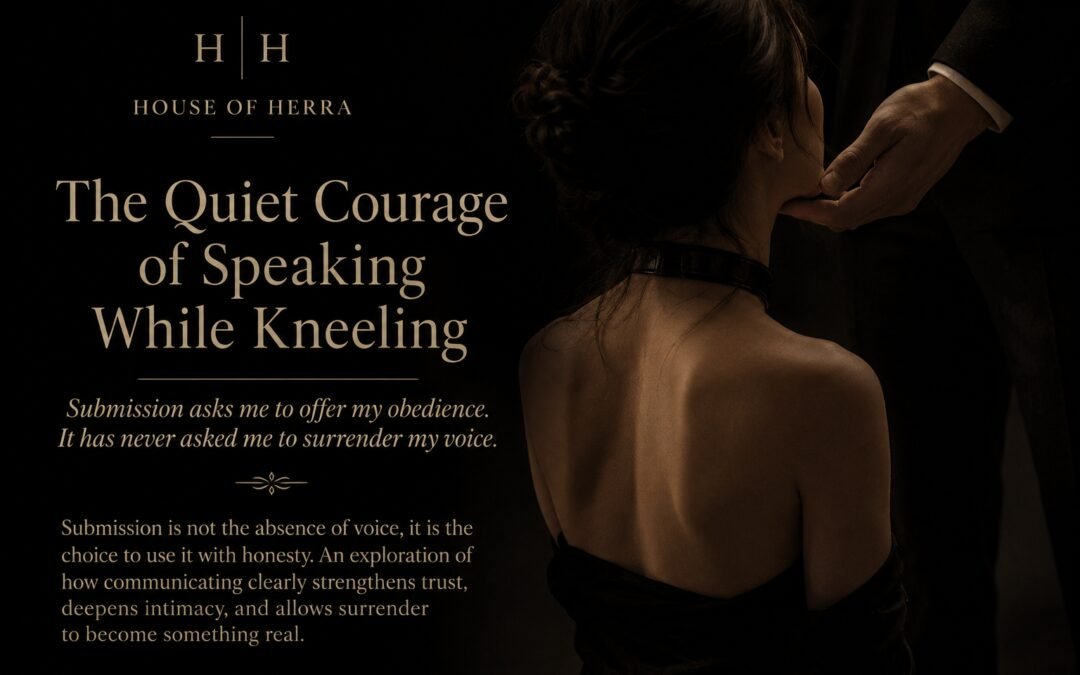
Submission asks me to offer my obedience. It has never asked me to surrender my voice.
There was a time when I believed the best submissives were the quiet ones.
Not because anyone had told me so directly, but because silence seemed to fit the role. The images I encountered, the stories people shared, even the language we sometimes use all suggested that the ideal submissive was agreeable, accommodating and endlessly compliant. They anticipated needs before they were spoken. They accepted correction without question. They made themselves smaller so that another could stand taller.
For a while, I mistook that silence for devotion.
It took me years to realise they were not the same thing.
One of the quiet paradoxes of submission is that it asks more of your voice, not less. The deeper I entered power exchange, the more I discovered that meaningful surrender was never built upon disappearing. It was built upon being known. And it is remarkably difficult to be known if you never allow yourself to be heard.
Perhaps that is why I no longer think of submission as the opposite of autonomy.
Instead, I have come to see it as one of the ways autonomy reveals itself.
People often assume that the defining characteristic of a submissive is obedience. I understand why. Obedience is visible. It can be observed from across a room. It is easy to recognise in protocol, ritual and service.
Choice is harder to see.
No one watching a scene can easily recognise the countless decisions that made that moment possible. The conversations that happened beforehand. The trust that was built over months. The limits that were negotiated. The fears that were admitted. The moments where both people quietly asked themselves whether they were ready to place something precious into another person's care.
Those decisions are less dramatic than a collar or a command.
They are also far more important.
Submission, at least as I have experienced it, has never been something another person took from me. It has always been something I chose to offer. That distinction changes everything.
Because if submission is something freely given, then it cannot require the surrender of the very person who is giving it.
It took me an embarrassingly long time to understand that.
Like many submissives, I worried that expressing discomfort might make me difficult. That asking questions might suggest a lack of trust. That admitting uncertainty somehow weakened the gift I wanted to offer.
Looking back, I wonder where those fears really came from.
Perhaps they came from confusing confidence with certainty. Perhaps they came from wanting desperately to be considered "good." Or perhaps they reflected something far more ordinary—the very human fear that honesty might cost us connection.
That fear exists well beyond BDSM.
How many people remain silent in friendships because they do not want to disappoint? How many partners avoid difficult conversations because conflict feels more frightening than resentment? How often do we convince ourselves that love means accommodation rather than authenticity?
Submission did not create those fears.
It simply gave me a place where I could no longer ignore them.
Power exchange has a curious way of exposing parts of ourselves we thought belonged to other areas of life. I expected to learn about service. I expected to learn about obedience. I expected to learn about restraint.
I did not expect to learn how uncomfortable I was with asking for what I needed.
There is an assumption, particularly among those new to D/s, that communication somehow belongs outside the dynamic. We negotiate beforehand, perhaps debrief afterwards, but once authority has been exchanged the submissive should simply follow.
Experience has taught me something rather different.
The healthiest dynamics I have known have contained extraordinary amounts of communication. Not less.
Sometimes that communication is formal. Sometimes it is playful. Sometimes it consists of long conversations over coffee that have nothing to do with scenes at all. Sometimes it is a single glance that asks a question only two people understand.
Communication changes shape.
It never becomes unnecessary.
I have learned that speaking honestly before a scene is an act of trust, not hesitation. Telling someone I am anxious today, distracted by work, carrying grief, or feeling unexpectedly vulnerable does not weaken the dynamic.
It allows the dynamic to respond to reality rather than fantasy.
The same is true during a scene.
There is a persistent myth that enduring discomfort without complaint somehow demonstrates greater submission. I have never found that to be true.
Silence can sometimes be courage.
It can also be fear.
The difficult part is learning the difference.
Using a safeword is not a failure of submission. Asking for a pause is not disobedience. Saying, "Something doesn't feel right," is not stepping outside the dynamic.
It is participating fully within it.
After all, what greater expression of trust exists than believing someone will hear you when you speak?
I sometimes think we misunderstand vulnerability because we imagine it only in moments of surrender.
Kneeling feels vulnerable.
Being restrained feels vulnerable.
Closing your eyes and placing your wellbeing into another person's hands feels vulnerable.
But there is another vulnerability that receives far less attention.
Saying, "I didn't enjoy that."
Saying, "I don't think I'm ready."
Saying, "I need something different."
Those words have often felt harder for me than kneeling ever did.
Not because they challenged authority, but because they required me to believe my own experience deserved space within the relationship.
That may be one of the quiet gifts submission has given me.
It has slowly dismantled the belief that my needs become less significant simply because I choose to serve.
Service and self-erasure are not synonyms.
One nourishes relationships.
The other eventually starves them.
I have also come to appreciate that a submissive's voice serves more than themselves. Honest reflection helps a Dominant understand the person entrusted to their care. Feedback allows both people to grow. A conversation after a scene often teaches us more than the scene itself.
No one benefits when politeness replaces honesty.
Not the submissive.
Not the Dominant.
Not the relationship.
The irony is that genuine authority rarely fears respectful truth.
In my experience, those most worthy of trust have never demanded silence from me. They have expected thoughtfulness, certainly. Respect, absolutely. But they have also wanted authenticity because authority exercised over performance is ultimately hollow.
Real power exchange happens between two real people.
Real people become tired.
They misunderstand one another.
They change.
They discover new desires and unexpected boundaries.
They carry old wounds into new relationships.
Pretending otherwise may preserve an illusion of perfection, but it does very little to sustain intimacy.
Perhaps that is why I no longer measure the strength of a D/s relationship by how perfectly the protocol is followed.
I notice different things now.
I notice whether difficult conversations feel safe.
Whether disagreement can exist without threatening affection.
Whether apologies are offered freely.
Whether curiosity survives certainty.
Whether both people continue to become more themselves rather than less.
These seem, to me, far better measures of trust than flawless obedience ever could be.
Submission has taught me many things over the years.
It has taught me patience, discipline and the quiet satisfaction that can be found in service offered freely. It has taught me the intimacy of ritual and the extraordinary tenderness that sometimes exists inside carefully negotiated authority.
But perhaps its most unexpected lesson has been this.
Finding my voice did not happen despite becoming a submissive.
It happened because submission eventually demanded that I stop confusing silence with surrender.
The deeper my submission became, the less interested I was in disappearing.
Instead, I found myself becoming increasingly visible—to another person, certainly, but also to myself.
That has proved to be the more demanding journey.
And, I suspect, the more enduring one.




Recent Comments