

Why earned submission asks more of both people than effortless obedience ever could.
There is a particular kind of confidence that rarely announces itself. It does not dominate every conversation or seek to win every disagreement. Instead, it watches. It asks questions. It waits.
Sometimes, it smiles before challenging you.
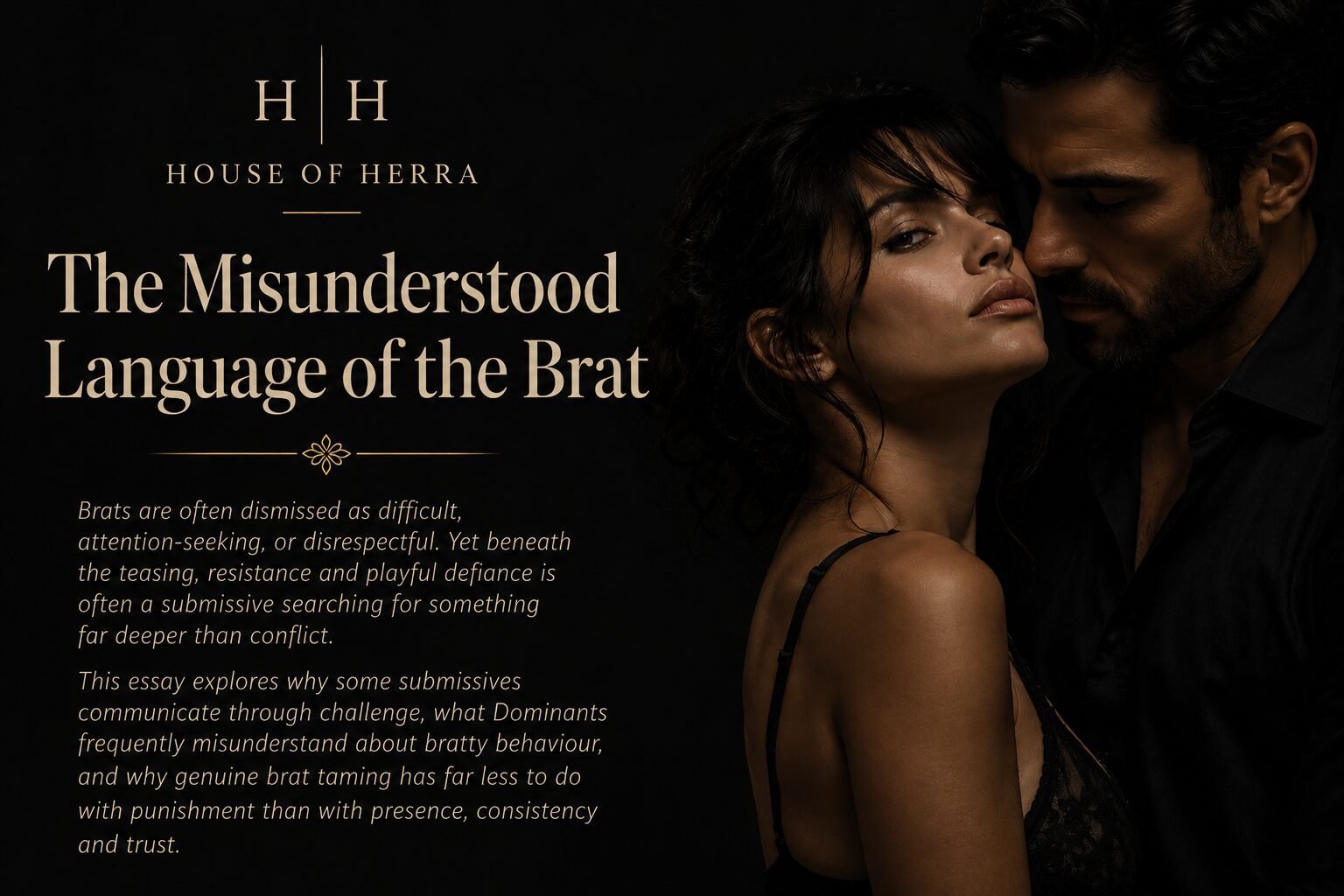
I've often thought that people misunderstand what they are seeing when they encounter someone they describe as "a brat." The word has become shorthand for disruption, immaturity or needless resistance. It suggests someone who enjoys making life difficult simply because they can.
Yet that has rarely matched what I've experienced.
Beneath the teasing, beneath the irreverence, beneath the deliberate push against boundaries, I have usually found something far quieter. Not a desire to undermine authority, but a reluctance to surrender to authority that has not yet revealed its character.
There is an important difference.
Many people assume submission begins with obedience. I have come to believe it begins much earlier than that. It begins with observation.
Before trust is ever offered, people watch how we respond to disappointment. They notice whether our confidence survives disagreement. They pay attention to how we carry ourselves when our expectations are frustrated. They are not simply evaluating our words. They are trying to discover whether the person standing before them is consistent enough to become emotionally safe.
A brat simply performs that process out loud.
Where another submissive might quietly wonder who you really are, the brat asks the question directly. Not always in words, but in behaviour. She interrupts certainty. She challenges assumptions. She creates moments where masks become difficult to maintain.
It is less an act of rebellion than an invitation to reveal yourself.
That distinction changes everything.
There is a temptation among inexperienced Dominants to see resistance as something to eliminate. Every challenge becomes a contest. Every sarcastic remark demands correction. Every moment of defiance is interpreted as disrespect.
Power becomes a performance that must constantly defend itself.
The irony is that genuine authority rarely feels threatened by being questioned.
People who know who they are seldom need to prove it every few minutes.
I've noticed that the strongest Dominants I have known possess an unusual stillness. They are not hurried into anger. They do not mistake emotional reactions for leadership. They understand that control exercised over another means very little if control over oneself is absent.
A brat discovers this quickly.
She is remarkably efficient at exposing insecurity because insecurity always rushes to defend itself. Ego reacts. Presence responds.
One demands obedience.
The other inspires it.
Perhaps this is why bratty submission is so often misunderstood. We speak as though it is a personality type when, in reality, it is often a language.
Resistance can communicate uncertainty.
Humour can disguise vulnerability.
Defiance can become a cautious request for reassurance.
The playful argument that appears trivial on the surface may conceal a much deeper question.
Will you still be yourself when I stop making this easy?
For anyone who has been disappointed by confidence that vanished under pressure, it is not an unreasonable question.
Trust has memory.
It remembers promises that dissolved.
It remembers certainty that collapsed at the first inconvenience.
It remembers people who spoke confidently about responsibility until responsibility became inconvenient.
Once you understand that, the brat begins to look rather different.
Her challenges are not necessarily attempts to seize power. More often, they are attempts to measure it.
Not its volume.
Its depth.
There is something profoundly human about wanting proof before vulnerability.
Outside BDSM, we recognise this instinct immediately. Friendships deepen through reliability. Love grows through consistency. Families become secure because people continue showing up when circumstances become difficult.
No one finds those expectations unreasonable.
Yet within power exchange, we sometimes imagine trust should appear simply because roles have been negotiated.
It rarely does.
Consent can establish the framework for authority, but only experience establishes confidence in the person exercising it.
Those are not the same thing.
Submission offered before trust can be beautiful.
Submission offered because trust has been repeatedly earned carries a different weight altogether.
It feels less like compliance and more like choice.
That distinction matters because genuine submission cannot be extracted. It can only be given.
No title creates it.
No protocol guarantees it.
No collar manufactures it.
These things may symbolise commitment, but symbols only carry meaning because of the relationship that breathes life into them.
Without that relationship, they become costumes.
With it, they become deeply significant.
I think this is why the moment a brat truly softens often feels unexpectedly emotional.
From the outside, very little has changed. She kneels. She follows an instruction. She uses an honorific she has perhaps resisted for weeks or months.
The behaviour itself is simple.
What has changed is everything underneath it.
The teasing no longer protects uncertainty.
The challenge no longer measures safety.
The resistance no longer asks whether you will remain steady.
She already knows the answer.
What remains is not defeat.
It is relief.
There is a quiet beauty in watching someone discover that they no longer need to remain guarded.
Not because they have been overpowered.
Because they have finally become convinced they are safe enough not to fight.
That is a very different kind of surrender.
It also explains why the relationship changes after that point.
People sometimes imagine that once a brat chooses to submit, the fire disappears.
In my experience, it rarely does.
The wit remains.
The confidence remains.
The independence remains.
The willingness to challenge ideas often remains too.
Healthy submission has never required someone to become smaller than they were before. It asks only that strength finds somewhere trustworthy to rest.
A spirited submissive does not suddenly become passive.
She simply stops spending energy wondering whether she must defend herself against the person she has chosen.
That energy becomes available for devotion instead.
And devotion born from freedom possesses extraordinary resilience.
It is not fragile because it was never dependent upon fear.
It survives disagreement because disagreement was always permitted.
It survives mistakes because the relationship was built upon communication rather than perfection.
It survives ordinary life because it was never sustained by fantasy alone.
Perhaps that is the greatest lesson a brat offers.
She quietly refuses shortcuts.
She reminds us that meaningful authority cannot be demanded into existence. It is built through patience, consistency, accountability and presence.
Not once.
Repeatedly.
There will always be people who prefer effortless obedience. There is nothing inherently wrong with simplicity when it genuinely reflects the people involved.
But there are others who find something deeply meaningful in knowing that every expression of trust has been consciously chosen.
That every act of submission carries within it a long history of observation.
That every kneeling body belongs to someone who remained fully capable of standing.
I have always found something profoundly moving about that.
Not because the struggle itself is romantic, but because what eventually emerges from it often feels remarkably honest.
When someone who has questioned, tested, laughed, challenged and observed finally places their trust in your hands, they are offering far more than obedience.
They are saying they have seen enough of who you are to believe they no longer need to protect themselves quite so fiercely.
Few gifts carry greater responsibility.
And perhaps that is why the brightest flames were never meant to be extinguished.
Only understood well enough that, one day, they choose to warm themselves beside yours.

Recent Comments