
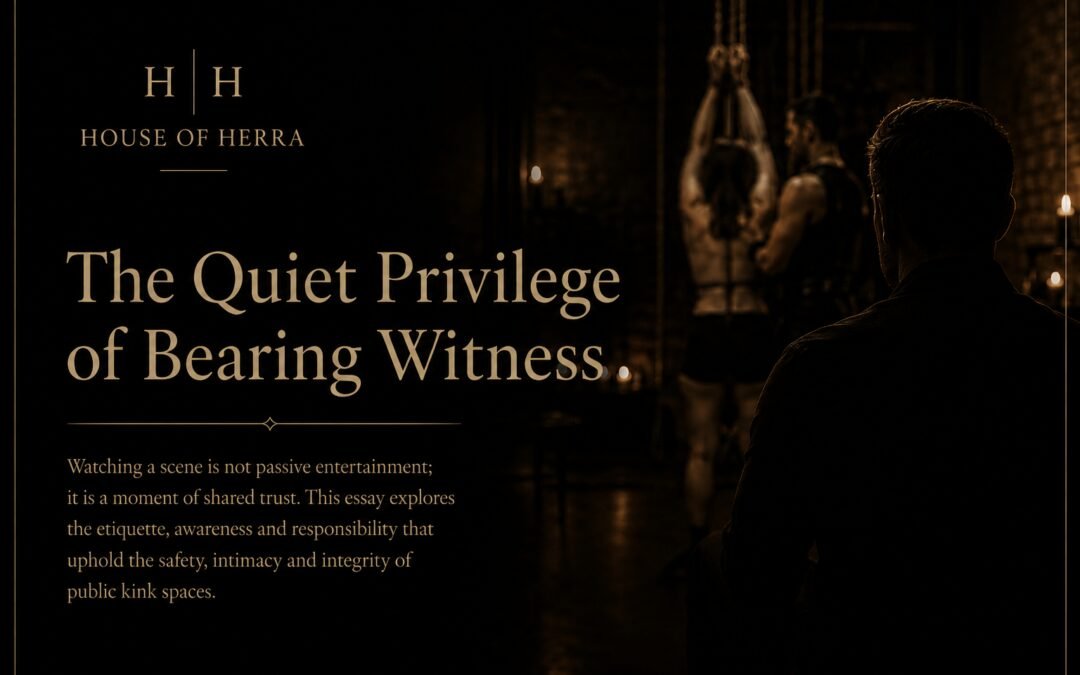
What we reveal by the way we watch says as much about our character as what others reveal through the scenes they create.
There is a particular silence that settles over a well-held scene.
Not the silence of absence, but of attention. Conversations fade into the background. People instinctively step back. Even those who have witnessed countless scenes seem to recognise that something worthy of respect is unfolding before them. It is one of the few moments in a public space where dozens of strangers quietly agree that this interaction belongs, first and foremost, to the people creating it.
I've often thought that watching a scene is one of the least discussed skills within BDSM.
Much is written about negotiation, communication, technique and aftercare. We rightly devote time to teaching people how to play safely, how to negotiate responsibly and how to care for one another afterwards. Yet very little is said about the role of those who are simply standing nearby.
Perhaps that is because observing appears passive. We imagine that doing nothing requires no thought.
In reality, doing nothing well can require remarkable discipline.
Public play spaces occupy a curious place within our community. They exist so people can learn from one another. They allow newcomers to see dynamics that books cannot adequately explain. They create opportunities for friendships, mentorship and inspiration. They remind us that BDSM is not merely a collection of techniques but a living culture shaped by countless acts of trust.
Yet the openness of these spaces can sometimes encourage an unfortunate misunderstanding.
Visibility is not an invitation.
A scene may be taking place in public, but that does not make it public property.
That distinction matters more than we sometimes realise.
Whenever two people enter a negotiated dynamic, they create something intensely personal. Whether the scene lasts ten minutes or two hours, whether it involves rope, impact, sensation or quiet service, they are constructing a temporary world built from communication, consent and vulnerability. Every movement has usually been discussed long before the first touch. Every limit has meaning. Every exchange rests upon countless conversations that no observer will ever hear.
What we witness is only the visible surface.
The foundations remain invisible.
That is worth remembering because spectators naturally create stories.
We see tears and wonder if someone is frightened. We hear cries and assume distress. We notice trembling and imagine harm. Outside the context of negotiation, these responses can appear alarming.
Inside a consensual dynamic, however, the same reactions may represent trust, catharsis, surrender or profound emotional release.
Experience has taught me to become suspicious of first impressions.
Human beings are remarkably poor at interpreting situations when they possess only fragments of the story. We instinctively fill missing information with assumptions. It is a habit that serves us well in everyday life but can become deeply misleading within BDSM.
The observer rarely knows what was negotiated.
They rarely know the relationship.
They rarely know the emotional history between the people involved.
Humility, then, becomes one of the most valuable qualities an observer can possess.
Not every mystery requires solving.
Respect also has a physical dimension.
Every experienced player develops an awareness of space. Around every active scene exists an invisible boundary that deserves to remain intact. Step too close and you become part of the environment the players must now accommodate. Your breathing, your movement, even your curiosity begin to occupy psychological space that was never offered to you.
It is remarkable how little distance is needed before presence begins to feel like intrusion.
If you are close enough that the participants become aware of you rather than each other, you have already crossed an invisible line.
Stepping back is rarely noticed.
Standing too close almost always is.
What has always fascinated me is that good etiquette often consists of making ourselves less significant.
We live in a culture that encourages participation. To comment. To react. To share opinions immediately. Silence is frequently mistaken for disengagement.
BDSM quietly teaches the opposite.
Sometimes the greatest contribution we can make is restraint.
Scenes do not require applause.
They do not require whispered commentary, shocked expressions or conversations conducted just loudly enough for others to hear. Even well-intentioned reactions can fracture concentration at moments when participants are deeply immersed in psychological states that demand extraordinary trust.
Subspace and similar headspaces are not performances.
Neither is dominance.
They are fragile experiences sustained through focus, communication and emotional safety.
Our reactions should never become another variable the participants must manage.
That same restraint extends beyond the scene itself.
There can be an understandable temptation to approach participants immediately afterwards. We may wish to compliment their technique, ask questions or express admiration. Sometimes those conversations are welcomed.
Sometimes they are not.
What we often forget is that a scene does not necessarily end when the implements are put away.
The emotional work frequently begins afterwards.
Aftercare may be unfolding quietly. A Dominant may be checking in while appearing outwardly composed. A submissive may still be processing sensations that have little visible expression. Both may simply wish to sit together in silence before re-entering the wider social space.
Approaching them because our curiosity feels urgent places our needs above theirs.
If conversation comes naturally later, wonderful.
If it does not, that too deserves respect.
There is another assumption I have noticed over the years.
People sometimes imagine that watching a scene grants them understanding.
It does not.
Watching someone tie beautiful rope does not reveal the years of trust that made stillness possible. Witnessing expertly delivered impact play tells us nothing about the conversations that established limits or the reassurance exchanged before arriving at the venue. Seeing remarkable service or ritual offers little insight into the ordinary days that sustain those moments.
We are witnessing an expression of a relationship, not the relationship itself.
That distinction protects us from reducing complex human connections into isolated performances.
Perhaps this is why gratitude feels more appropriate than evaluation.
A simple, sincere thank you acknowledges something important.
Someone chose to make themselves vulnerable in a space where others could learn. They accepted being seen without asking to become entertainment. In doing so, they contributed quietly to the education of everyone present.
That is no small gift.
It deserves appreciation rather than critique.
Of course, there are exceptions.
Safety remains everyone's responsibility, although not everyone's role.
If genuine danger emerges—medical emergency, obvious equipment failure or a clear violation of consent—intervention becomes an act of care rather than intrusion. Community depends upon people willing to protect one another when necessary.
The wisdom lies in recognising the difference between discomfort and danger.
They are not the same thing.
Many scenes are intentionally intense.
Intensity alone should never be mistaken for crisis.
Knowing when not to intervene requires as much maturity as knowing when intervention becomes essential.
I've also come to believe that every observer carries responsibility for something else entirely: their own internal experience.
Public BDSM can stir unexpected emotions. Curiosity. Admiration. Excitement. Envy. Arousal. Unease. Even grief for relationships we once had or wish we had found.
None of these responses are inherently wrong.
They are simply human.
The responsibility lies in recognising that our emotional experience belongs to us, not to the people creating the scene. They are not responsible for regulating our discomfort or validating our excitement. They owe us nothing beyond the boundaries already established by sharing a public space.
If we find ourselves overwhelmed, we are free to leave quietly.
Sometimes that is the kindest decision available.
Not because we have failed, but because self-awareness is another form of respect.
When people ask me what good etiquette looks like in a dungeon, they often expect a list of rules.
Rules matter.
They create clarity.
But good etiquette has always seemed to me to arise from something deeper than memorising expectations.
It begins with recognising that every person around us possesses an inner world we cannot fully see.
The Dominant concentrating on every strike.
The submissive navigating trust one breath at a time.
The rigger checking every tension point.
The dungeon monitor quietly observing from the edge of the room.
Each is carrying responsibilities invisible to everyone else.
Our role as observers is not to add weight to those responsibilities.
It is to lighten them through our own conduct.
Perhaps that is the quiet privilege of witnessing another person's scene.
We are invited, however briefly, into a moment built from courage, communication and extraordinary trust. We are allowed to see something deeply human expressed through the language of BDSM. The invitation is generous, but it is never unconditional.
It asks something of us in return.
Not applause.
Not commentary.
Simply the grace to remember that the most respectful observer is often the one whose presence is barely noticed at all.




Recent Comments