
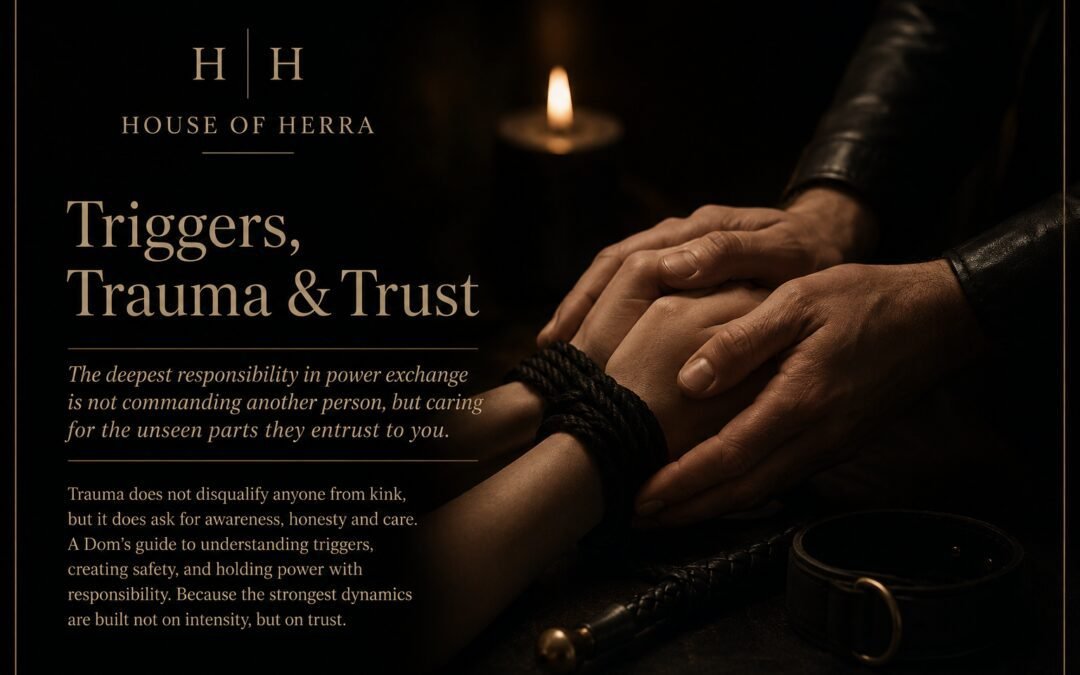
The deepest responsibility in power exchange is not commanding another person, but caring for the unseen parts they entrust to you.
There is a moment that arrives in almost every enduring Dominant/submissive relationship when you realise you are no longer negotiating activities. You are being entrusted with history.
Not the carefully curated history people choose to tell at dinner parties, nor the polished version that appears in online profiles. Something quieter than that. Older. More fragile. The collection of experiences that have shaped how someone responds to fear, intimacy, touch, vulnerability and control.
Power exchange has a curious way of bringing those hidden places into the light.
It is one of the reasons I have come to believe that BDSM is never truly about implements, protocols or positions. Those things matter, of course, but only because they create opportunities for two people to encounter each other with unusual honesty. The rope is not the relationship. The blindfold is not the trust. The title of Dominant or submissive is never the destination.
The people always come first.
That truth becomes especially important when trauma enters the conversation.
Trauma is often misunderstood because we speak about it as though it belongs to the past. We describe events that happened years ago and imagine the wound remains there, neatly contained within memory. Yet trauma rarely behaves so politely. It has a habit of stepping into the present without invitation.
A person may know they are safe while every part of their nervous system insists otherwise.
That contradiction is difficult to explain to someone who has never experienced it. The conscious mind may recognise the room, the partner and the consent that has been freely given, while the body reacts as though it has returned to a place it hoped never to revisit.
Trauma is not simply remembering.
It is reliving.
This is why conversations about triggers deserve far more care than they often receive.
A trigger is not weakness. It is not attention seeking. Nor is it evidence that someone is incapable of participating in kink. It is simply the nervous system recognising something familiar and responding before reason has the opportunity to intervene.
Sometimes that recognition arrives through obvious things. A particular phrase. A certain restraint. A specific role-play scenario.
Sometimes it arrives through something almost impossible to predict. A scent. The sound of a belt being unfastened. A change in someone's tone of voice. The weight of silence in a room.
To an outside observer, the reaction may appear disproportionate.
To the person experiencing it, the danger feels entirely real.
Understanding this changes the way we think about responsibility within BDSM.
I have never believed that a Dominant's responsibility begins when the scene starts or ends when the aftercare finishes. It begins much earlier, in conversation, curiosity and patience. Long before a hand is raised or an instruction is given, trust is already being built.
Or quietly broken.
One of the greatest mistakes I see is the belief that negotiation exists merely to establish limits and choose activities. Those things matter, but the deeper purpose of negotiation is understanding.
Understanding how someone experiences vulnerability.
Understanding what safety feels like for them.
Understanding what experiences have shaped the person kneeling in front of you.
These conversations are rarely comfortable. They ask people to reveal parts of themselves they may have spent years protecting. There is courage in admitting that certain words still hurt. There is courage in saying, "I don't know why this affects me, only that it does."
That courage deserves to be met with respect rather than interrogation.
A Dominant does not need every detail of another person's past. Curiosity is not entitlement. What matters is understanding enough to create an environment where trust can continue to grow instead of being unintentionally damaged.
That distinction is easily forgotten.
There is a subtle temptation within some corners of the kink community to treat healing as another challenge to overcome. As though enough courage, enough exposure or enough determination can simply erase the effects of trauma.
I have never found that to be true.
Healing rarely responds well to force.
It responds to consistency.
To predictability.
To the repeated experience of discovering that someone who could exploit your vulnerability chooses not to.
In many ways, this is where healthy power exchange becomes something remarkable. Consent creates structure. Structure creates safety. Safety allows vulnerability. And vulnerability, when honoured rather than exploited, can slowly rewrite expectations that have existed for years.
Not because BDSM possesses magical therapeutic qualities.
Because healthy relationships do.
That distinction matters.
There are people for whom consensual kink becomes part of reclaiming ownership over experiences that once left them powerless. Choosing restraint after surviving coercion can carry profound personal meaning. Choosing pain freely is fundamentally different from having suffering imposed upon you. Within the right relationship, agency itself can become deeply restorative.
Yet these possibilities should never be romanticised.
Kink is not therapy.
A scene cannot repair trauma simply because it feels emotionally significant. Sometimes it can illuminate wounds neither partner realised were present. Sometimes it raises questions that require the support of experienced mental health professionals rather than another scene.
Recognising that is not failure.
It is maturity.
The healthiest Dominants I know possess an unusual willingness to say, "This is beyond my ability to hold."
There is wisdom in understanding where care ends and treatment begins.
Perhaps this is why I become uneasy whenever people speak about pushing limits as though growth is measured by endurance alone.
Sometimes the bravest decision in a dynamic is deciding not to explore something.
Not because it is inherently dangerous.
Because the timing is wrong.
Because trust is still developing.
Because someone's emotional foundations need strengthening before new challenges are introduced.
Boundaries are often misunderstood as restrictions placed upon pleasure. In reality, they are the framework that allows intimacy to flourish without fear.
Respecting a boundary is rarely the end of an experience.
More often, it is the beginning of a relationship that can survive difficult moments.
And difficult moments do arrive.
Despite careful negotiation, honest communication and genuine care, someone may still become triggered during a scene. Human beings remain wonderfully complex. We cannot predict every response, nor should we pretend otherwise.
What matters then is not perfection.
It is presence.
Stop.
Remove expectation.
Create safety before seeking explanation.
In those moments, I have learned there is very little wisdom in asking immediate questions. The nervous system is not waiting for analysis. It is searching for evidence that the danger has passed.
Calm voices matter.
Gentle consistency matters.
Simple reassurance matters.
Only later, when breathing steadies and emotions settle, does reflection become useful.
Not to assign blame.
Not to determine who failed.
But to understand together what happened.
Some scenes strengthen relationships because they are exhilarating.
Others strengthen relationships because they reveal how two people care for each other when everything becomes unexpectedly difficult.
I suspect the latter matters more.
There is another truth that deserves saying aloud.
Dominants are not immune to being triggered themselves.
Power does not erase history.
Leadership does not remove vulnerability.
The expectation that a Dominant should remain emotionally invulnerable at all times creates impossible standards that ultimately help no one. We bring our own experiences into every dynamic, our own fears, our own unresolved moments, our own humanity.
The difference is not that one partner carries wounds while the other does not.
The difference is that both partners accept responsibility for understanding themselves well enough to protect each other.
That is where trust becomes something far richer than confidence.
Trust is not believing nothing difficult will ever happen.
Trust is believing that when it does, neither of you will be left to face it alone.
Perhaps that is why I no longer think the measure of a good Dominant lies in how intense their scenes become, how impressive their protocol appears or how confidently they occupy authority.
I think it lies elsewhere.
In whether someone feels safer for having placed their vulnerability in your hands.
Because long after the bruises have faded, the rope has been untied and the collars returned to their hooks, that is what remains. Not the performance of power, but the memory of how carefully it was held.
And in the end, that may be the most profound form of dominance there is.




Recent Comments