

Sometimes the greatest challenge for a Dominant is not learning new skills, but remembering that presence has always mattered more than performance.
There is a quiet danger in becoming competent.
It rarely arrives with failure. More often, it arrives with success. You spend years learning your craft, refining your technique, understanding anatomy, practising safely, building confidence with every scene until the things that once demanded your full attention begin to happen almost without thought.
What once required concentration becomes instinct.
And that is precisely when something essential can begin to disappear.
I've often thought that every Dominant has a comfort zone, whether we recognise it or not. It might be rope, protocol, psychological play or service. Mine became impact. I immersed myself in it. I studied implements, learned how different materials behaved, understood where to strike and where never to strike. I became fascinated by rhythm, pacing and the subtle conversation that exists between each stroke and every breath that follows.
There is undeniable beauty in good impact play. A well-delivered scene carries its own rhythm. The body responds almost musically. Breath changes. Muscles soften or tighten. Trust reveals itself one moment at a time.
It is easy to fall in love with that language.
The difficulty is remembering that it is only one language.
Somewhere along the way, without ever intending to, I allowed my confidence with impact to become something else. The implements began to occupy more of my attention than the person standing before me. I found satisfaction in precision. I appreciated the symmetry of marks, the timing of each strike, the technical elegance of a well-constructed scene.
Nothing was unsafe.
Nothing was careless.
From the outside, everything probably looked exactly as it should.
Yet internally something had shifted.
The scenes still worked, but they no longer breathed.
Looking back, I realise I had slipped into something many people experience, regardless of whether they practise BDSM. I had confused competence with connection.
It is a mistake that exists far beyond kink.
Teachers begin delivering lessons they no longer truly inhabit. Musicians play pieces flawlessly while thinking about dinner. Couples say "I love you" with complete sincerity but without genuine presence because the words have become familiar enough to survive without attention.
Routine has a remarkable ability to disguise absence.
Dominance is no different.
There was one afternoon that made this impossible to ignore.
It was the second scene of the day. Everything was progressing well. My submissive was beautifully responsive. Her breathing matched the rhythm I had established. Her body accepted each strike with the trust I had come to know so well.
Then, quite unexpectedly, I paused.
Not because anything was wrong.
Simply because something inside me felt strangely hollow.
She froze instantly.
The stillness between us felt heavier than everything that had happened before it.
Only afterwards did I understand why.
During that entire sequence, I could remember every swing I had delivered.
I could not remember looking into her eyes.
My attention had become divided. Part of me remained with her, but another part had been occupied by execution. I was performing a role I knew well instead of inhabiting it completely.
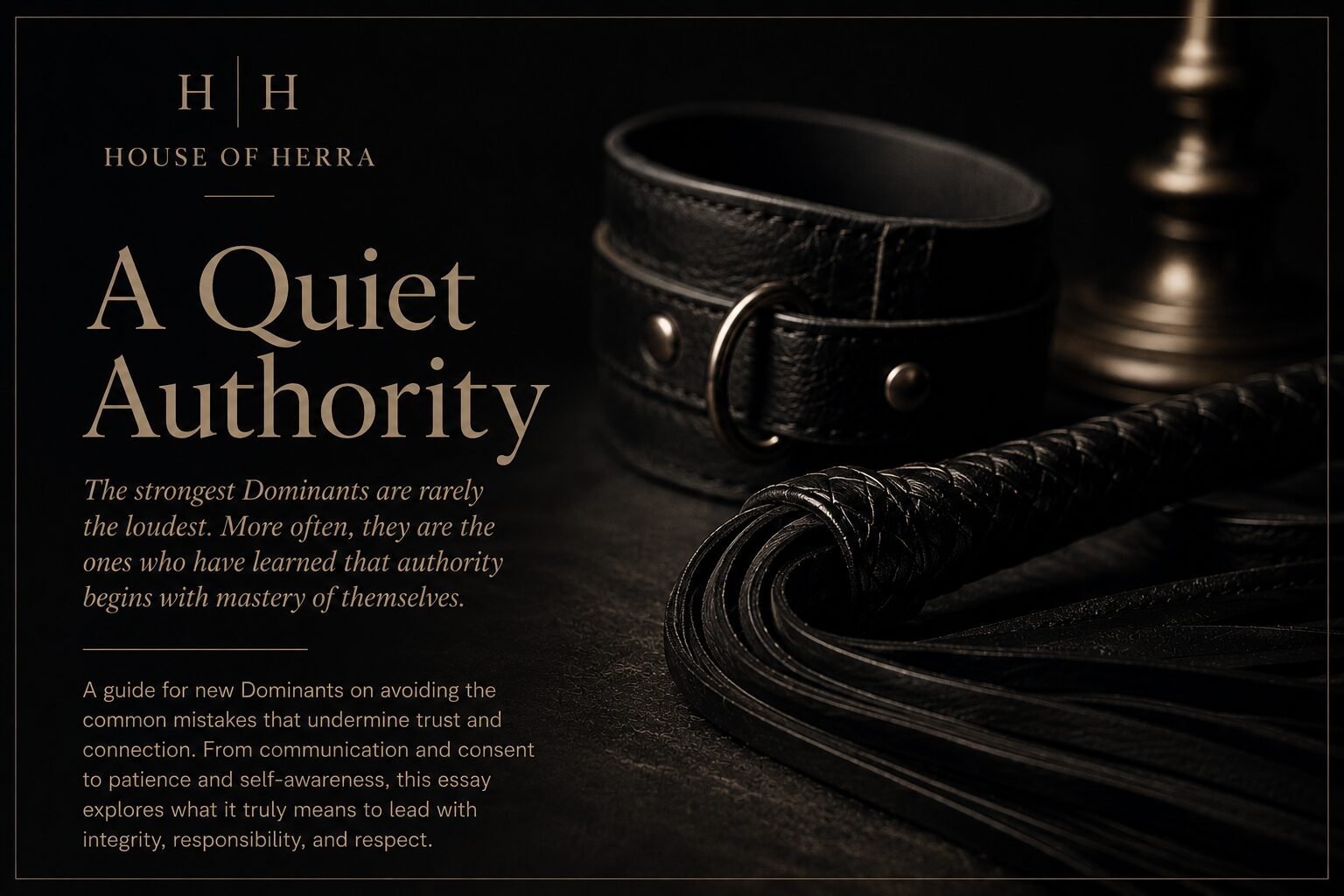
The cane had become more than a tool.
It had become somewhere to hide.
That realisation was deeply uncomfortable because it challenged an assumption I had carried for years—that becoming more skilled naturally meant becoming a better Dominant.
Skill certainly matters.
Responsibility demands it.
A Dominant who neglects technique has no business wielding implements capable of causing harm.
But technical excellence is not the same thing as emotional presence.
One protects the body.
The other nurtures trust.
Without both, something important is missing.
I have come to believe that presence is perhaps the rarest quality we can offer another human being.
Not attention in the casual sense.
Presence.
The kind that notices a hesitation before words arrive.
The kind that recognises a subtle change in breathing.
The kind that understands silence can communicate more honestly than conversation.
Presence asks us to stop managing the scene long enough to experience it.
That is considerably harder than mastering a swing.
So I made a decision that surprised me.
For a while, I deliberately placed many of my favourite implements aside.
Not because there was anything wrong with them.
Because there was something incomplete in me.
I wanted to rediscover who I was without the reassuring structure they provided.
At first it felt strangely uncomfortable.
Impact had become familiar territory. It offered immediate feedback. Every strike produced a response. Every sound reassured me that something was happening.
Without those familiar rhythms I felt exposed.
I had to discover other ways of creating tension.
A quiet instruction.
A prolonged silence.
The space between two people standing only inches apart.
The deliberate restraint of choosing not to act.
Those moments taught me more than I expected.
One evening I simply told her not to move.
Nothing followed.
No strike.
No command beyond the first.
I stood behind her, saying nothing, matching my breathing to hers until the silence itself seemed almost tangible.
The anticipation became almost unbearable.
There were no marks.
No dramatic sounds.
No spectacle.
Yet the intensity between us exceeded scenes that had involved far more elaborate play.
That was the moment I recognised what I had been searching for.
Power had never resided in the cane.
It had always resided in attention.
The implements merely amplified whatever already existed between us.
When presence was strong, they deepened it.
When presence weakened, they merely disguised its absence.
That distinction has changed how I approach every scene.
Now, before I reach for any implement, I find myself asking quieter questions.
Why this?
Why now?
What am I hoping this moment will communicate?
Because every action communicates something, whether we intend it to or not.
A strike can encourage.
It can reassure.
It can challenge.
It can celebrate resilience.
It can invite surrender.
But only if intention precedes execution.
Otherwise it is simply movement.
I think this is true of dominance itself.
People often imagine authority as something visible—commands, protocol, posture, implements, ritual.
Those things certainly have their place.
But the authority that leaves the deepest impression is often almost invisible.
It is the calm certainty that asks nothing for itself.
It is patience.
It is restraint.
It is the confidence to allow silence to remain silent.
Most of all, it is the willingness to remain emotionally available while another person entrusts themselves to your care.
That vulnerability belongs to the Dominant as much as the submissive.
We do not often speak about that.
Perhaps because vulnerability appears to contradict our role.
Yet I have found the opposite.
The Dominants I admire most are rarely those who appear invulnerable.
They are the ones courageous enough to remain fully present.
To notice.
To adapt.
To admit when habit has replaced intention.
To put familiar tools aside long enough to ask difficult questions of themselves.
That kind of self-examination is not weakness.
It is responsibility.
I still love impact play.
I suspect I always will.
There is artistry in it that continues to fascinate me.
The rhythm.
The trust.
The extraordinary conversation that can exist without many words.
But I no longer mistake the conversation for the language itself.
The tools have returned to my hands.
Only now they feel lighter.
Not because they matter less, but because they no longer carry the burden of creating authority for me.
They simply express something that already exists.
Perhaps that is the lesson I needed all along.
Not that a cane can become a crutch, but that anything can.
Technique.
Titles.
Protocol.
Experience.
Even confidence.
Whenever any of those become substitutes for genuine presence, they quietly stop serving us and begin protecting us from the very connection we set out to create.
In the end, the moments I remember most are rarely the loudest.
They are the pauses.
The shared breath before movement.
The quiet look that says more than a hundred perfectly delivered strikes ever could.
Because true dominance has never depended on the sound of a cane meeting skin.
It has always depended on the person holding it.

Recent Comments