
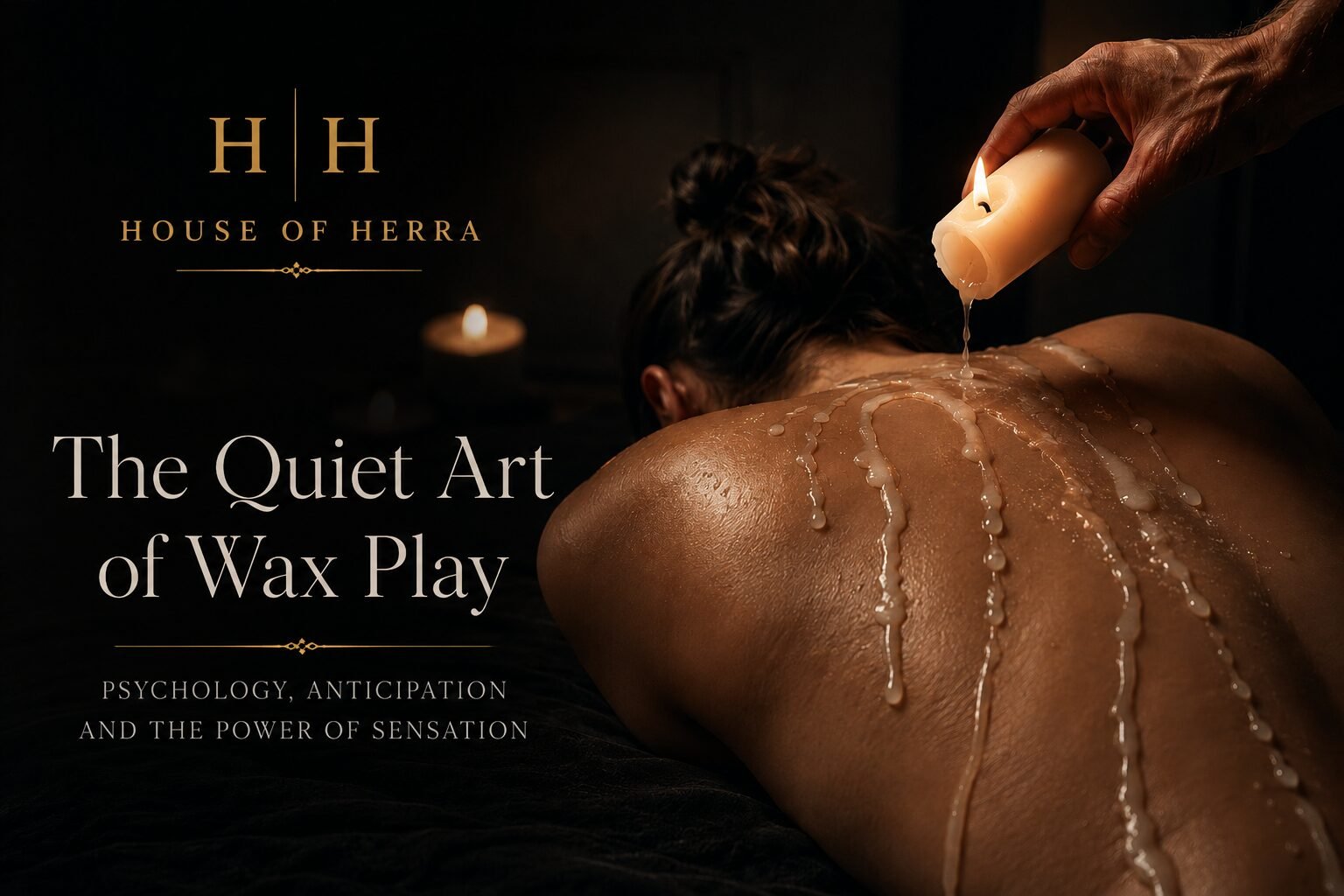
The Quiet Art of Wax Play
More Than Melted Wax
There is a temptation, when people first encounter wax play, to see it as little more than spectacle.
A lit candle. Warm wax. A sharp intake of breath.
It photographs beautifully. It appears dramatic. To someone unfamiliar with BDSM, it can seem like another theatrical flourish—a visual effect designed to shock or impress. Those impressions are understandable. They also miss the point entirely. Like so many forms of sensation play, wax is remarkable not because of what it is, but because of what it allows two people to create together. The candle itself is ordinary. The experience is anything but.
At House of Herra, we believe that the practices which endure are rarely defined by the tools involved. A collar does not create commitment. A flogger does not create authority. Rope does not create trust. Neither does a candle create intimacy.
People do.
Wax play is simply another language through which two people communicate. Sometimes that language is playful. Sometimes deeply erotic. Sometimes quietly meditative. Occasionally challenging. Always revealing.
Understanding that changes everything.
Instead of asking, "How hot is the wax?", we begin asking more meaningful questions.
- Why does anticipation often feel more intense than the sensation itself?
- Why can a single drop become the defining moment of an entire scene?
- How does someone willingly surrender to an experience they know will sting—and trust it completely?
Those questions tell us far more about wax play than any candle ever could.
Wax Play Begins in the Mind
Before the first drop ever reaches the skin, the experience has already begun. The Dominant lights the candle. The flame flickers. The receiver hears movement behind them. Nothing happens. A few more seconds pass. Still nothing.
By now the body has already started responding. Breathing changes. Muscles prepare themselves. The imagination begins filling the silence with possibilities. When the first drop finally lands, it often feels larger than physics alone can explain.
This is anticipation.
Unlike impact play, where movement is visible, or restraint, where pressure is continuous, wax exists within uncertainty. The candle tilts. Nothing happens. Then without warning a single warm drop lands. The physical sensation lasts only a heartbeat. The anticipation may have lasted an entire minute. That imbalance is precisely what gives wax play its unique psychological power.
The body prepares repeatedly for an event that has not yet occurred. Every movement of the Dominant's hand becomes meaningful. Every pause invites expectation. Experienced Dominants understand that anticipation frequently produces more emotional intensity than the sensation itself. Imagination has always been one of the most powerful instruments within consensual power exchange. Wax simply gives it room to work.
Sensation Rather Than Pain
One of the greatest misconceptions surrounding wax play is that it exists primarily to cause pain. Certainly, it can. But reducing wax play to pain alone misunderstands both its versatility and its purpose.
Warm wax can soothe. It can surprise. It can tease. It can create a brief sting that dissolves almost immediately into warmth. It can invite laughter. It can slow breathing. It can encourage mindfulness.
For many people, the attraction lies not in enduring discomfort but in experiencing contrast.
Warm wax against cool skin. A sudden sting followed by comfort. Heat giving way to calm. The experience continually evolves.
Unlike many forms of sensation play, wax rarely remains consistent. Every drop behaves differently. The candle changes as it burns. The room temperature shifts. Skin warms gradually throughout the session. Tiny variables accumulate until no two moments are ever exactly alike. That unpredictability is not a flaw. It is part of the attraction.
Trust Matters More Than Temperature
Newcomers almost always begin with the same question. "How hot should the wax be?" It is a perfectly reasonable question. It is also the wrong place to start. Long before discussing temperatures, wax blends or candle selection, we should ask something far more important.
Is there enough trust between the people involved?
Trust allows honest feedback. Trust allows hesitation. Trust allows someone to admit something feels uncomfortable without fearing disappointment. Trust allows a Dominant to stop immediately without feeling that the scene has somehow failed. Without trust, technical knowledge has surprisingly little value. The safest candle in the world becomes unsafe if communication has already broken down. Conversely, two people who communicate openly will often identify small concerns long before they become significant problems. That is why negotiation remains the foundation of every successful wax scene. Not because negotiation removes uncertainty, but because it creates confidence that uncertainty will be managed responsibly.
Consent Is a Continuous Conversation
Consent is often spoken about as though it happens before the scene begins. Reality is rather different. Consent continues throughout the experience. The discussion beforehand establishes intentions.
The scene itself becomes another conversation. Every hesitation. Every smile. Every change in breathing. Every request. Every pause. Each becomes part of an ongoing dialogue.
Wax play encourages this naturally because every drop creates another opportunity to communicate. Unlike activities involving continuous stimulation, wax provides countless natural pauses. The next drop has not yet happened. That simple fact gives both people extraordinary freedom. To slow down. To change direction. To stop. To continue. Communication becomes continuous rather than contractual. That distinction is one of the reasons experienced practitioners value wax so highly.
Choosing the Right Candle
Eventually every beginner asks the same practical question. "Which candle should I buy?" The answer is usually less exciting than expected. The safest choice is rarely the prettiest candle on the shelf. Nor is it necessarily the most expensive.
Candles intended specifically for body contact are formulated with skin safety in mind. They typically use wax blends that melt at significantly lower temperatures than many decorative household candles. Their purpose is sensation. Not decoration. Decorative candles are designed for entirely different priorities.
- Appearance.
- Fragrance.
- Colour.
- Burn time.
- Atmosphere.
Skin contact is seldom part of their design brief. That distinction matters.
Many people assume that because a candle is safe to burn in the dining room, it must also be safe to pour onto skin. The assumption is understandable. It is also incorrect. Decorative candles may contain fragrance oils, dyes or wax formulations that behave very differently once they leave the wick.
Responsible wax play begins by respecting those differences instead of assuming all candles are interchangeable.
The Myth That "Soy Means Safe"
Within BDSM communities one piece of advice appears again and again. "Just use soy candles." It is well intentioned. Unfortunately, it is also incomplete. Many soy waxes melt at lower temperatures than traditional paraffin blends, making them attractive for sensation play. That reputation has gradually evolved into something more simplistic. People now assume soy automatically means safe. Reality is considerably more nuanced. Different manufacturers formulate soy wax differently. Some remain soft. Others harden quickly. Some retain heat surprisingly well. Others cool almost immediately. The label tells us remarkably little.
Responsible practitioners learn not merely what a candle is made from, but how that particular candle behaves.
Good judgement will always be more valuable than convenient assumptions.
Preparation Is Part of the Scene
Experienced practitioners understand that scenes begin long before the first sensation. Preparation shapes confidence. Confidence encourages relaxation. Relaxation influences every sensation that follows. A protected surface allows participants to focus on one another rather than worrying about cleaning wax from carpets later.
Everything needed should already be within easy reach.
- Water.
- A cool cloth.
- Basic first-aid supplies.
- A stable place to rest lit candles safely.
None of these preparations suggest pessimism. They demonstrate responsibility. There is an important difference. Preparing for unlikely problems does not make them more likely. It simply means they can be handled calmly if they arise. That calmness is often contagious. The receiver recognises that the Dominant has anticipated the practical realities of the scene.
Quiet competence is reassuring. And reassurance, more often than people realise, deepens surrender.
Looking Ahead
Understanding wax play begins with understanding people. The candle matters. The wax matters. Technique certainly matters. But psychology, communication and trust matter far more.
In Part Two, we move from principles to practice.
We will explore:
- Choosing genuinely body-safe candles.
- Preparing your play space.
- Safe pouring distances.
- Suitable body areas.
- Avoiding burns.
- Cleaning wax safely.
- Common beginner mistakes.
- Building confidence for your first complete wax scene.
Because confidence is rarely created by courage alone. More often, it is created by preparation.
More in this series:
- The Quiet Art of Wax Play - Part 1
- The Quiet Art of Wax Play - Part 2
- Wax Play: Understanding Heat - The Science that makes wax play safe
- Wax Play: Beyond the flame
- Wax Play: A Practical Guide to your first scene - Part 1
- Wax Play: A Practical Guide to your first scene - Part 2
- Wax Play: A Practical Guide to your first scene - Part 3
- Recommended Sellers UK
Stay up to date on new articles by following the House of Herra on Instagram
0 Comments