
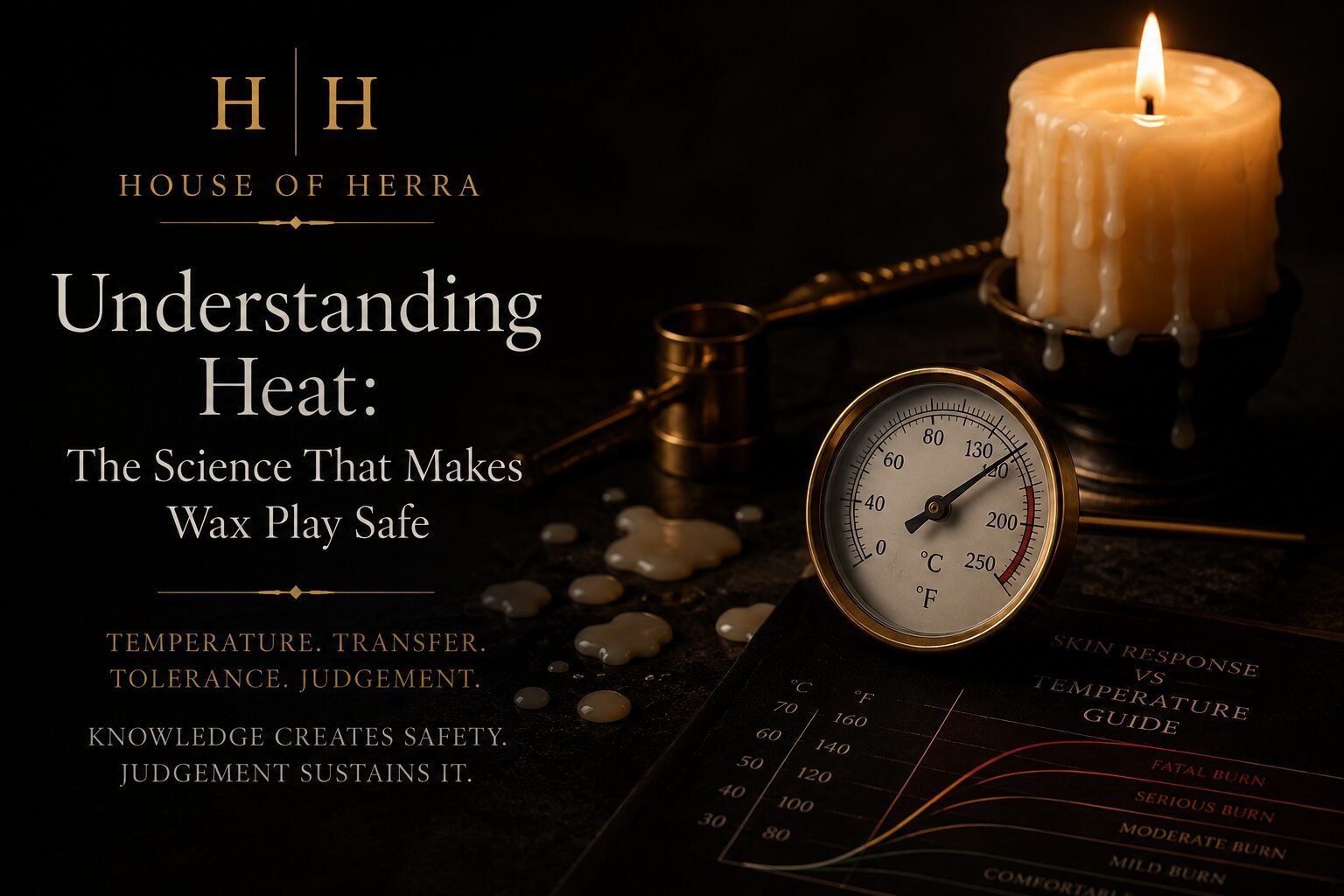
Understanding Heat: The Science That Makes Wax Play Safe
Why Good Judgement Matters More Than Melting Point
If wax play has a single piece of advice that has survived longer than almost any other, it is this:
"Use low-temperature wax."
It is sensible advice. It is also incomplete.
For years, conversations surrounding wax play have tended to revolve around one number: the melting point of the candle. Entire purchasing decisions are often based upon it. Candles are described as safe or unsafe almost entirely because of the temperature at which they become liquid.
While melting point is certainly important, treating it as the only measure of safety creates a dangerous illusion of certainty.
It suggests that once the correct candle has been chosen, the difficult thinking is over.
In reality, it has only just begun.
Wax play is governed by far more than a single temperature. It is influenced by chemistry, physics, technique, environment and human judgement. Every one of these factors changes how heat behaves once the wax leaves the candle and lands upon another person's skin.
Understanding those interactions does not remove risk. It allows risk to be managed intelligently. That distinction matters.
At House of Herra, we have often argued that knowledge is not the accumulation of facts but the development of sound judgement. Wax play illustrates this principle beautifully. Two people may use exactly the same candle and achieve entirely different outcomes, not because one candle changed, but because the people using it understood the material differently.
The Problem with Simple Answers
Communities naturally develop rules of thumb. They make learning easier. They help beginners avoid obvious mistakes. Sometimes they become accepted so completely that few people pause to question them. Wax play has accumulated several such rules over the years.
"Soy is safe."
"Paraffin is dangerous."
"Low melting point means low risk."
Each contains an element of truth. None tells the whole story.
The difficulty with simplified advice is not that it is entirely wrong. The difficulty is that it often encourages people to stop asking questions at precisely the moment curiosity would serve them best.
Materials behave differently. Manufacturers formulate products differently. Environmental conditions vary. Human bodies vary even more.
Reducing all of that complexity to a single ingredient or temperature inevitably leaves important information behind. Responsible practitioners learn to become sceptical of absolute statements. Not cynical. Simply curious enough to ask what else might be influencing the outcome.
What Does a Melting Point Actually Tell Us?
When people discuss melting point, they are referring to the temperature at which solid wax becomes liquid. It is an important characteristic because wax obviously cannot drip until this transition has occurred.
However, this number tells us only when the transformation begins. It tells us surprisingly little about what happens next. Imagine two candles that melt at broadly similar temperatures. One produces small, thin droplets that begin cooling almost immediately as they fall. The other produces thicker drops that retain heat noticeably longer after leaving the wick. Despite comparable melting points, the experience upon the skin will differ. The reason is simple. Melting point describes the beginning of the journey. The receiver experiences everything that happens afterwards.
Heat Is Only Half the Story
When discussing burns, temperature naturally dominates the conversation. Yet biology introduces another variable that deserves equal attention. Time. Anyone who has accidentally touched a hot baking tray knows that a brief contact and prolonged contact produce entirely different outcomes.
The same principle governs wax play.
The skin is remarkably capable of tolerating brief exposure to elevated temperatures. Problems arise when heat continues transferring into tissue for longer than the body can safely dissipate it. This is why a fleeting sensation can remain thrilling while prolonged contact at a similar temperature may become harmful. The body does not experience temperature in isolation. It experiences temperature over time. Understanding this single principle changes the way many experienced practitioners think about wax entirely. Rather than asking only "How hot is it?", they also begin asking, "How long does it remain hot?" The second question is often the more revealing one.
Not All Soy Wax Behaves Alike
Few materials have acquired as reassuring a reputation within wax play as soy wax.
In fairness, that reputation did not emerge without reason. Many soy formulations are well suited to sensation play, particularly when compared with decorative candles designed solely for room lighting. The difficulty arises when soy becomes treated as a guarantee. It is not. Soy is not one substance. It is a category. Within that category exist numerous formulations developed for different purposes. Some are intended for container candles. Others for pillars. Some prioritise appearance. Others scent throw. Others hardness. Others burn time. Each behaves differently.
Even among products marketed as soy candles, melting characteristics, viscosity, cooling behaviour and heat retention can vary considerably. This explains why experienced wax players often speak less about ingredients and more about individual products. The label tells part of the story. Observation tells the rest.
The Shape of the Candle Matters Too
It is easy to assume that once a wax has been selected, the candle itself becomes little more than a convenient container. In practice, the shape of the candle influences the experience almost as much as the wax it contains.
Consider a narrow taper.
Wax accumulating near the flame often has little opportunity to cool before gravity carries it over the edge. The droplets tend to form quickly, producing a sharper sensation.
Now consider a broader pillar candle.
Liquid wax frequently gathers into a shallow pool before finally spilling over the edge. During those extra moments, some heat naturally dissipates. The resulting droplets may reach the skin at a noticeably different temperature despite originating from the same wax.
The wax has not changed. Its journey has. This illustrates a recurring theme throughout wax play: behaviour frequently matters more than specification. Knowing how something behaves will almost always prove more useful than memorising its technical description.
Distance Is a Cooling Mechanism
One of the simplest techniques available to anyone practising wax play requires no specialist equipment at all. It involves patience.
As molten wax travels through the air, it loses heat. The greater the distance,within sensible limits, the more opportunity there is for cooling to occur before contact with the skin. This is why experienced practitioners often adjust drip height rather than immediately reaching for a different candle when seeking subtle changes in sensation. The effect is not dramatic. Nor should it be. Wax play rewards refinement rather than extremes. Small adjustments frequently produce meaningful differences.
Attempting to solve every problem by changing wax overlooks the equally important role played by technique.
The Environment Is Always Participating
It is tempting to imagine wax play occurring only between two people.
In reality, the room itself quietly participates. A cool environment encourages faster cooling. A warm room may prolong it. Skin that has already been warmed through massage, blankets or previous play behaves differently from skin that has only recently been exposed. Even airflow can influence how rapidly droplets lose heat before contact. None of these variables requires obsessive measurement. They simply deserve awareness.
Experienced Dominants develop the habit of observing context rather than assuming every scene begins under identical conditions. Consistency is achieved through adaptation, not repetition.
Technique Cannot Replace Attention
There is understandable comfort in believing that mastering technique eventually removes uncertainty. Unfortunately, people do not behave with the consistency of laboratory equipment. One evening a receiver may welcome sensations they find overwhelming the following week.
Fatigue. Stress. Medication. Illness. Hormonal changes. Emotional state. Every one of these influences perception.
The candle remains unchanged. The person does not.
This is why attentive Dominants never become technicians alone. They remain students of the individual standing before them. Their greatest skill lies not in pouring wax. It lies in recognising when today's scene requires yesterday's assumptions to be abandoned.
Science Should Support Judgement, Not Replace It
Understanding the physics of wax play is undeniably valuable.
Knowing how heat moves. How wax cools. How different formulations behave. How candle geometry alters sensation. All of this contributes to safer practice.
Yet science alone cannot tell us when a partner has become uncertain.
It cannot detect hesitation hidden behind a smile. It cannot replace empathy. Nor can it substitute for conversation. Knowledge is a tool. Judgement decides how that tool is used. This is perhaps the most important lesson science can teach within BDSM.
The more we understand the mechanics, the more we appreciate the irreplaceable value of human awareness.
Conclusion
There is comfort in simple answers. They reduce uncertainty. They offer confidence. Unfortunately, the body is rarely simple. Neither is heat.
Wax play exists at the meeting point of chemistry, physics, psychology and trust. Remove any one of these elements and the experience becomes poorer. Ignore one of them entirely and it may become unsafe.
Melting point matters. Materials matter. Technique matters. Environment matters. But none of them matters as much as the person holding the candle. Because candles do not make decisions. People do.
The safest practitioner is therefore not the one who owns the most carefully engineered wax.
It is the one who never stops observing, never stops asking questions and never mistakes familiarity for certainty.
That quiet discipline, not the label on the candle, is what truly makes wax play safe.
More in this series:
- The Quiet Art of Wax Play Part 1 - More Than Melted Wax
- The Quiet Art of Wax Play Part 2- Reading the Flame, Reading the Person
- Understanding Heat: The Science That Makes Wax Play Safe
- Beyond the Flame: Judgement, Technique and Responsibility in Wax Play
- Wax Play: A Practical Guide to Your First Scene (Part 1)
- Wax Play: A Practical Guide to Your First Scene (Part 2)
- Wax Play: A Practical Guide to Your First Scene (Part 3)