
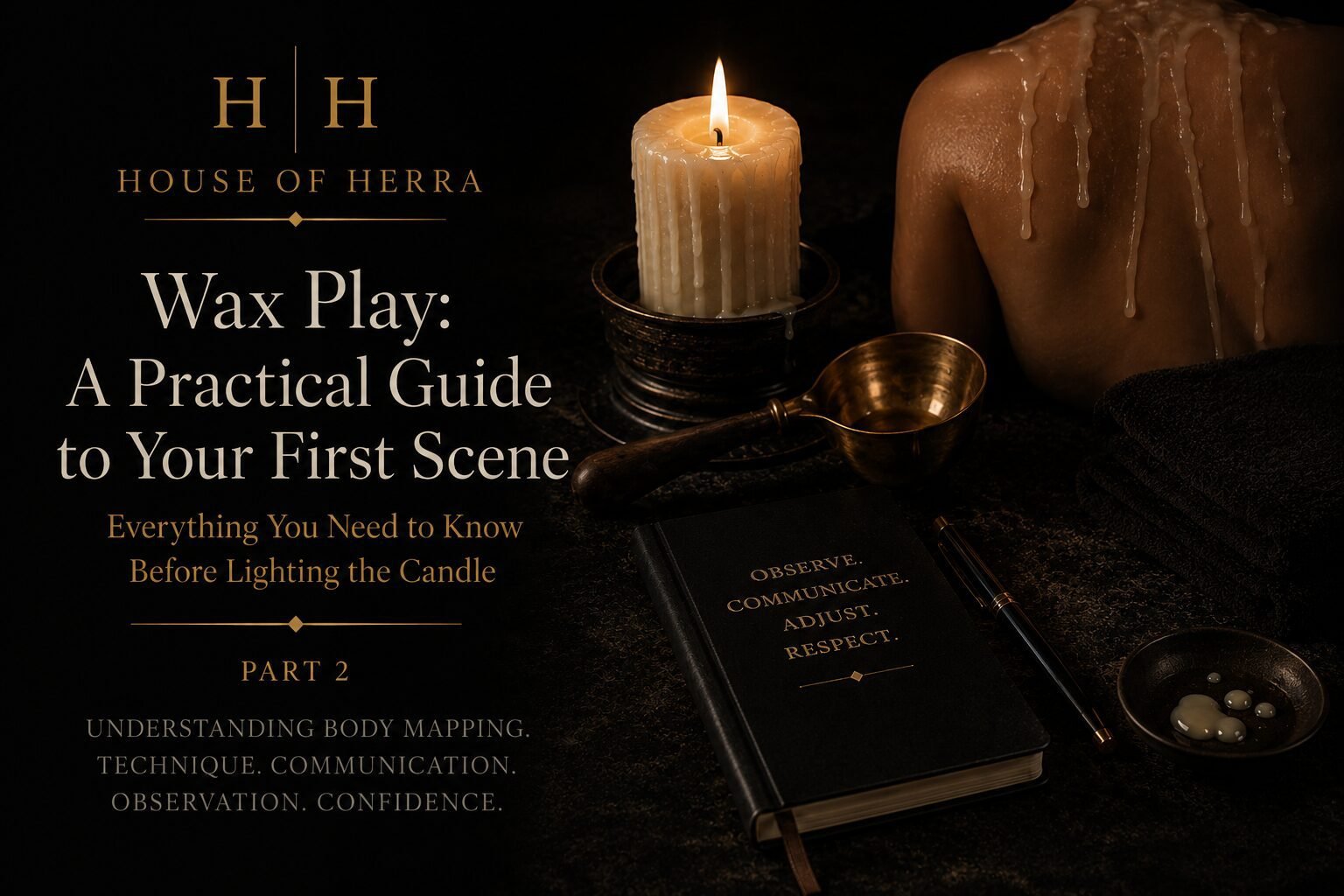
Wax Play: A Practical Guide to Your First Scene Part 2
Understanding Body Mapping
One of the most valuable habits you can develop in wax play is learning to think beyond where the wax first lands.
Molten wax behaves like any other liquid. Once it leaves the candle, gravity begins shaping its journey. A perfectly aimed drop can travel several centimetres across the body, following natural contours before finally cooling and solidifying. Without considering that movement, wax may reach areas you never intended to touch.
This is why experienced practitioners think in terms of body mapping rather than simply aiming.
Before every pour, consider three simple questions:
- Where will the wax land?
- Where is it likely to run?
- Where will it finally stop?
Beginning with broad, relatively flat areas allows you to answer those questions without unnecessary complexity, giving both partners the opportunity to learn how the wax behaves before introducing more challenging techniques.
Areas Well Suited to Beginners
For a first scene, choose areas with generous muscle coverage and relatively consistent sensation. These regions generally provide enough surface area for wax to cool naturally while allowing both participants to observe its movement and temperature.
Suitable starting areas include:
- Upper back
- Shoulder blades
- Upper shoulders
- Middle back
- Outside of the thighs
- Buttocks (with appropriate discussion beforehand)
These areas should never be considered universally "safe" or "easy." Every body experiences heat differently. Instead, think of them as sensible starting points where observation and communication can take precedence over intensity.
Areas Requiring Greater Care
As confidence grows, many people choose to explore more sensitive parts of the body. These areas often produce stronger sensations because of thinner skin, increased nerve density or the way molten wax behaves after contact.
Examples include:
- Breasts
- Abdomen
- Back of the knees
- Inner thighs
- Lower back
None of these areas are inherently off-limits. They simply require more experience, slower progression and more frequent communication. Successful wax play is rarely about bravery. It is about good judgement.
Areas Best Avoided
Until you have significant experience and a thorough understanding of both the material and your partner's responses, avoid dripping wax onto:
- Eyes
- Eyelids
- Inside the ears
- Face
- Lips
- Genitals
- Broken skin
- Sunburned skin
- Recently shaved or damaged skin
- Fresh tattoos
- Inflamed or irritated areas
These locations are more vulnerable to injury and offer little educational value during a first scene. Developing reliable technique on safer areas will always produce better long-term results than attempting unnecessarily advanced placements.
Performing a Patch Test
Even if you have used the same candle many times before, begin every scene with a fresh test.
Small changes can influence how wax behaves, including:
- Room temperature
- Candle age
- Previous burn time
- Skin temperature
- Air movement
Testing takes only moments.
Apply a single drop to yourself first and observe:
- How quickly it falls
- How warm it feels
- How rapidly it cools
- How it solidifies
Only then should you apply a small test drop to your partner.
Never assume that yesterday's candle will behave exactly the same way today.
Testing demonstrates responsibility, not uncertainty.
Beginning Your First Scene
A first wax scene should never feel rushed. There is no need to create dramatic photographs. There is no need to impress anyone. There is certainly no need to cover someone's body in wax. The objective is simply to understand how the material behaves while learning how your partner experiences it. Progress measured in curiosity is far more valuable than progress measured in spectacle.
Step 1 — Light the Candle
Allow the candle sufficient time to develop a stable pool of molten wax. Attempting to pour too early often produces inconsistent drops and unpredictable temperatures. Patience at the beginning usually results in a smoother, more controlled scene.
Step 2 — Test the Wax
Never skip the test.
Apply a drop to yourself. If necessary, allow the candle to burn slightly longer or cool briefly before continuing. Experienced practitioners test because conditions change, not because they doubt their abilities.
Step 3 — Explain What Will Happen
If your partner is new to wax play, describe the experience before the first drop.
Many people notice a sequence of sensations:
- anticipation
- warmth
- a brief sting
- cooling
- gentle tightening as the wax hardens
Knowing what to expect often reduces unnecessary anxiety and allows attention to remain on the experience itself rather than uncertainty.
Step 4 — Begin Slowly
Start with a single drop.
Then pause. Observe.
Ask:
"How did that feel?" Would they like another? Would they prefer a different height? Should the pace slow down?
The conversation should continue naturally throughout the entire scene. Communication is not something completed beforehand; it remains part of the scene from beginning to end.
Understanding Drip Height
One of the easiest ways to alter sensation is by changing the distance between the candle and the skin.
Lower Height
Generally produces:
- warmer wax
- quicker contact
- stronger sensation
Higher Height
Generally produces:
- slightly cooler wax
- softer impact
- more opportunity for cooling before contact
Small adjustments often create surprisingly noticeable differences.
Avoid pouring from excessive heights where accuracy becomes unpredictable. Control will always produce better scenes than spectacle.
Observe Before You Pour Again
Avoid establishing a rhythm too quickly. Instead, pause between pours and observe.
Ask yourself:
- Has the previous wax cooled?
- Is your partner relaxing?
- Have muscles become tense?
- Has breathing changed?
- Is the wax travelling as expected?
These observations should determine the pace of the scene far more than habit or excitement.
Reading Your Partner
Communication extends well beyond spoken words.
Positive indicators often include:
- Relaxed breathing
- Smiling
- Comfortable posture
- Curiosity
- Verbal enthusiasm
These usually suggest that the experience is progressing comfortably.
Pay equal attention to signs that indicate you should pause.
Examples include:
- Sudden muscle tension
- Flinching
- Holding their breath
- Pulling away unexpectedly
- Silence after previously offering feedback
- Hesitation
- Uncertainty
None of these automatically mean the scene should end. They simply suggest that it is time to stop, check in and decide together how—or whether—to continue.
Less Is Usually Better
Many newcomers imagine successful wax play involves covering the body with layers of hardened wax. Experienced practitioners often do precisely the opposite. A handful of carefully placed drops can create far more anticipation than continuous pouring ever could.
Remember:
You are creating an experience. Not decorating a body.
Combining Wax with Other Sensations
As confidence develops, wax can be combined thoughtfully with other forms of sensation, including:
- Feathers
- Gentle massage
- Ice
- Soft restraints
- Impact play
- Blindfolds
For beginners, however, simplicity remains the better teacher. Mastering one sensation thoroughly provides a far stronger foundation than introducing several before understanding any of them well.
Common Beginner Mistakes
Nearly every newcomer makes mistakes. Fortunately, most are easily avoided.
Common examples include:
- Choosing decorative candles instead of body-safe candles.
- Skipping the patch test.
- Pouring too quickly.
- Ignoring where wax will travel.
- Allowing excessive pooling.
- Forgetting to communicate.
- Trying to impress rather than observe.
- Assuming more wax automatically creates a better experience.
- Neglecting preparation.
- Rushing aftercare.
None of these mistakes define your ability. Every experienced practitioner began as a beginner. Competence develops through patience, observation and thoughtful repetition—not speed.
Looking Ahead
In Part 3, we will complete this practical guide by exploring:
- Safe wax removal techniques
- Cleaning equipment and play spaces
- Physical and emotional aftercare
- The importance of checking in the following day
- Frequently asked beginner questions
- A pre-scene checklist
- A concise quick-reference guide for future scenes
More in this series:
- The Quiet Art of Wax Play Part 1 - More Than Melted Wax
- The Quiet Art of Wax Play Part 2- Reading the Flame, Reading the Person
- Understanding Heat: The Science That Makes Wax Play Safe
- Beyond the Flame: Judgement, Technique and Responsibility in Wax Play
- Wax Play: A Practical Guide to Your First Scene (Part 1)
- Wax Play: A Practical Guide to Your First Scene (Part 2)
- Wax Play: A Practical Guide to Your First Scene (Part 3)