
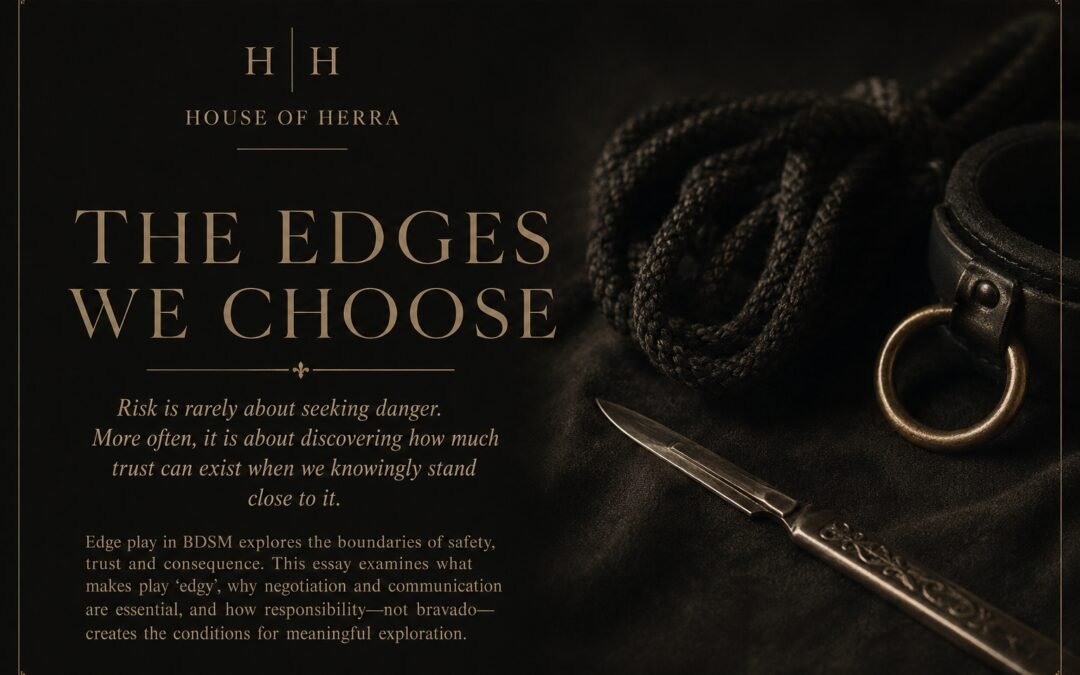
Risk is rarely about seeking danger. More often, it is about discovering how much trust can exist when we knowingly stand close to it.
There is a quiet misconception that has followed BDSM for as long as I have been part of it. Many people imagine that those drawn to power exchange are fascinated by danger itself, forever searching for something more extreme, more shocking, more forbidden than what came before. It makes for compelling stories, but it bears little resemblance to the people I have come to know.
Most are not chasing danger at all.
They are chasing honesty.
Edge play simply happens to be one of the places where honesty becomes impossible to avoid.
The phrase itself carries an undeniable weight. It suggests standing on the boundary between safety and uncertainty, between confidence and consequence. That image is not entirely inaccurate. Yet the edge is rarely defined by the activity itself. More often, it is defined by the people involved and the understanding they bring with them.
What feels routine to one couple may feel unimaginable to another. A single activity cannot be labelled universally dangerous or universally safe because every relationship carries its own history, experience, vulnerabilities and levels of trust. The edge is personal long before it is practical.
Perhaps that is why I have become less interested in asking what someone does and more interested in asking how they arrived there.
The journey matters far more than the destination.
There is a temptation within every community to create invisible ladders of experience. We speak about beginners and veterans, about soft limits and hard limits, about exploring further, pushing deeper, becoming more advanced. It is easy, if we are not careful, to mistake complexity for maturity.
Experience is not measured by how close someone comes to the edge.
It is measured by how often they choose not to step over it.
One of the most valuable lessons BDSM has taught me is that restraint is rarely celebrated because it is invisible. Nobody applauds the scene that never happened because someone recognised they were too tired. There are no stories told about the negotiation that ended with both people deciding tonight simply wasn't the right night.
Yet those moments often reveal more wisdom than the scenes that eventually unfold.
Choosing not to proceed can be every bit as intentional as choosing to begin.
Edge play makes this impossible to ignore because the consequences of poor judgement become increasingly significant. Activities involving breath restriction, blades, blood, fire or intense psychological scenarios are often discussed together because they introduce risks that cannot be entirely removed through enthusiasm or good intentions.
Knowledge helps.
Preparation helps.
Communication helps.
None of them eliminate risk.
That reality makes some people uncomfortable. We live in a culture that often treats enough research as a substitute for uncertainty, as though reading another article or attending another workshop somehow guarantees safety. Education is indispensable, but it has limits. The body remains unpredictable. The mind remains unpredictable. Relationships remain unpredictable.
No amount of confidence changes biology.
No amount of experience removes human fallibility.
I sometimes wonder whether this is what separates genuine confidence from misplaced certainty.
The experienced Dominants I admire most rarely speak as though they have mastered risk. Instead, they speak with quiet respect for it. They understand that responsibility is not about controlling every possible outcome. It is about recognising that some outcomes cannot be controlled at all.
That awareness changes the way they negotiate.
Negotiation is often reduced to a checklist of limits, safewords and activities. Those things matter enormously, but meaningful negotiation reaches much further than logistics.
It asks questions that cannot be answered with yes or no.
What are you hoping to feel?
What worries you about this?
What happens if either of us discovers we were wrong?
How will we recognise the difference between discomfort that serves the scene and discomfort that asks us to stop?
Those conversations are rarely dramatic. In fact, they are often remarkably ordinary. They sound less like contract negotiations and more like two thoughtful people trying to understand one another before placing something precious into each other's care.
Trust grows there.
Not during the scene.
Before it.
One of the greatest misunderstandings surrounding edge play is that bravery belongs to the person enduring the experience.
Sometimes it does.
But there is another kind of courage that receives far less attention.
The courage to refuse.
To stop.
To disappoint expectations.
To admit uncertainty.
To say, "I don't know enough yet."
For a Dominant, that may mean acknowledging a technique they are not ready to attempt. For a submissive, it may mean recognising that curiosity has arrived before emotional readiness. Neither admission represents failure.
They represent integrity.
Power exchange has always fascinated me because it reveals character under unusual circumstances. Authority without responsibility quickly becomes something ugly. Submission without agency becomes something equally troubling. Healthy dynamics survive because both people continue exercising judgement, even while embracing roles that appear unequal from the outside.
Edge play amplifies this truth.
Control becomes less about directing another person and more about directing oneself.
Perhaps this is why conversations around frameworks such as Safe, Sane and Consensual or Risk-Aware Consensual Kink sometimes miss the deeper point. People occasionally debate them as though choosing one philosophy over another settles the question of safety.
It does not.
Both frameworks are attempts to describe something that cannot be perfectly contained by language.
One reminds us to value safety wherever possible. The other reminds us that complete safety is sometimes an illusion.
Neither removes the responsibility to think.
Neither replaces communication.
Neither absolves anyone from continuing to learn.
In the end, frameworks are maps.
Relationships are the territory.
There is another edge that receives far less attention, and I suspect it is the one most people encounter first.
The psychological edge.
Not fear of physical injury, but fear of being truly seen.
Activities involving humiliation, vulnerability, fear or emotional exposure are sometimes spoken about as though they leave no marks because they do not break the skin. Yet emotional experiences have their own aftercare. Words linger. Memories linger. A carefully constructed scene can awaken unexpected feelings that neither person anticipated.
This is why aftercare is never simply about blankets, water or reassurance.
It is about returning to one another as equals.
About asking what the experience meant rather than merely whether it was enjoyable.
About recognising that intensity does not always reveal itself immediately.
Sometimes the most important conversation happens the following morning.
Or the following week.
One thing I have learned over the years is that the most responsible people in BDSM are rarely the ones eager to tell you how fearless they are.
They are usually the ones who speak most openly about caution.
They ask questions.
They revisit assumptions.
They continue learning despite years of experience.
They understand that confidence without humility becomes complacency remarkably quickly.
Perhaps that is the quiet lesson hidden inside edge play.
The edge is never simply the blade, the flame, the rope or the role.
The real edge is believing we have nothing left to learn.
Everything else is merely technique.
Because in the end, the greatest responsibility in BDSM has never been managing risk perfectly. It has always been caring for another human being with enough honesty to recognise when the next step forward is not towards the edge at all, but back into conversation.




Recent Comments