

The quiet art of responding to the human being before you rather than the scene you imagined.
Some of the most memorable moments I have experienced within a D/s dynamic were never planned.
They were not written into a negotiation. They were not listed in a scene outline or discussed over coffee beforehand. They emerged quietly, almost unnoticed, in the space between certainty and intuition. A pause that lasted a heartbeat longer than expected. A change in breathing. Fingers curling around a bedsheet. A smile that appeared when pain became something else entirely.
Those moments have taught me something that years of reading books and attending workshops never could.
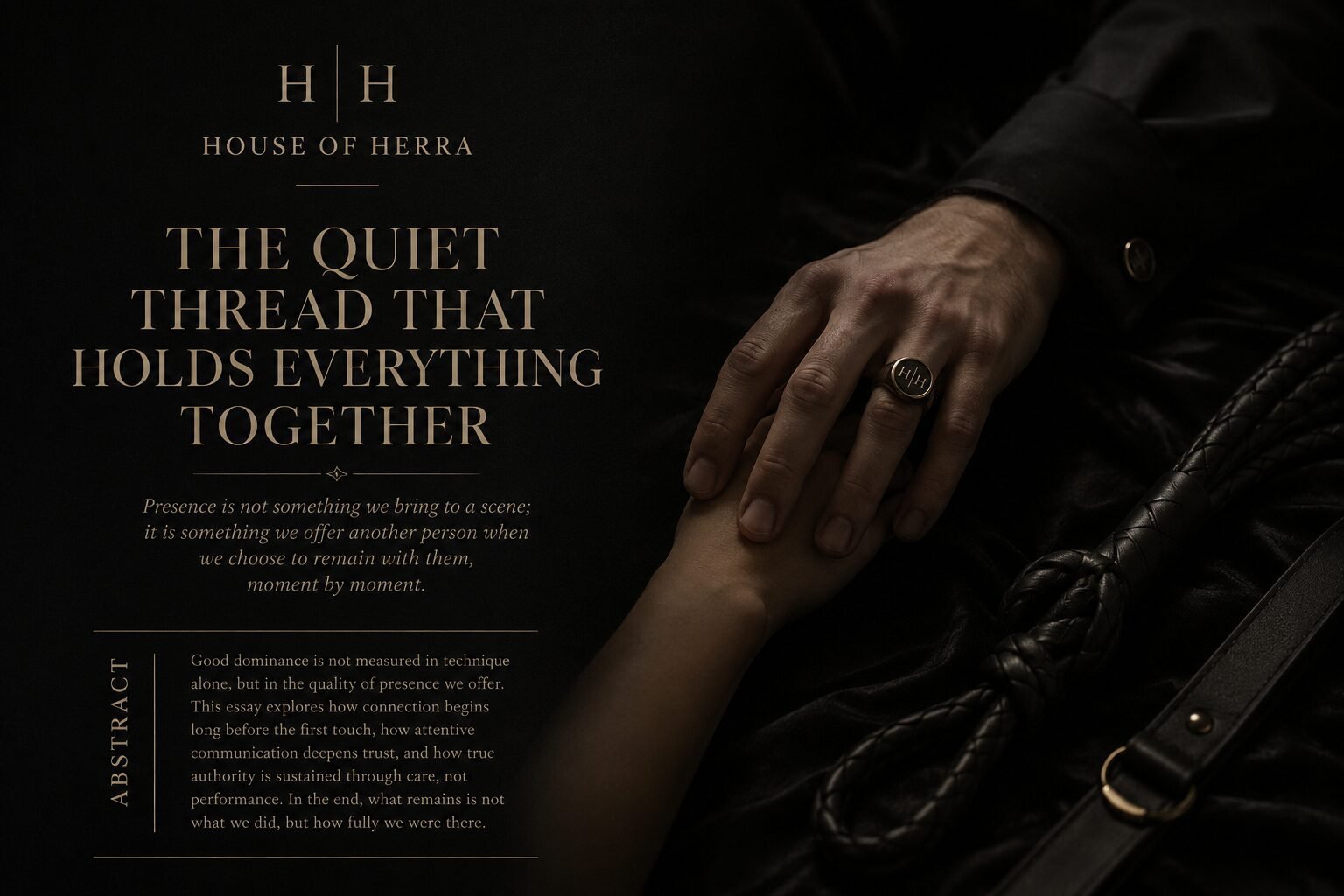
A scene may begin with a plan, but it comes alive through presence.
I have never believed that preparation is optional. Negotiation remains one of the most profound acts of care a Dominant can offer. Before a hand is raised, before a command is spoken, before a collar is fastened, there should already exist an understanding of limits, expectations, medical considerations, emotional vulnerabilities and, above all else, consent.
Without those foundations, there is no trust.
Without trust, there is no meaningful exchange of power.
Yet I have also come to realise that preparation has a shadow side. There comes a point where a meticulously constructed scene can begin to resemble a theatrical performance rather than an intimate conversation. Every movement becomes anticipated. Every response expected. Every moment measured against what was supposed to happen next.
When that happens, something quietly disappears.
Not excitement.
Not intensity.
Presence.
Beyond the Script
There is comfort in certainty.
Especially for those still finding confidence in their Dominance, a written sequence can feel reassuring. It reduces uncertainty. It offers direction. It provides something tangible to hold onto when nerves threaten to interfere.
There is nothing inherently wrong with that.
Every experienced Dominant began somewhere, and structure often creates the confidence needed to develop experience safely.
The difficulty arises when the script becomes more important than the person standing in front of you.
Human beings are wonderfully inconsistent creatures.
The submissive who melts beneath your voice one evening may crave silence the next. Someone who eagerly embraces heavy impact one month may arrive emotionally exhausted after a difficult week and find that the gentlest touch carries greater emotional weight than the hardest strike.
Bodies change.
Minds change.
Stress changes us.
Grief changes us.
Joy changes us.
Relationships change us.
If we assume that yesterday's responses guarantee today's experience, we stop seeing the individual and begin interacting with our own expectations instead.
Dominance, at its best, requires far more attention than authority.
It asks us to remain curious.
Learning to Listen Without Words
One of the greatest misconceptions about communication within BDSM is that it only occurs through speech.
Of course, words matter.
Negotiation matters.
Safewords matter.
Check-ins matter.
But once a scene begins, language often becomes something much richer than conversation.
I have often found that the most honest communication happens long before anyone says a single word.
A slight hesitation before kneeling.
A deeper breath before impact.
Shoulders relaxing rather than tensing.
Eyes that soften instead of searching.
Hands that reach unconsciously for reassurance.
None of these signals exist in isolation. Any single gesture can mean many things. What matters is recognising patterns—understanding the unique language that develops between two people who have invested time in learning one another.
Reading a submissive is not mind-reading.
It is attentive observation.
It is noticing.
It is asking when uncertainty exists.
It is remaining humble enough to accept that even after years together, another person will always possess an inner world you cannot fully know.
Perhaps that humility is one of the greatest strengths a Dominant can cultivate.
Presence Is More Powerful Than Performance
Modern culture often encourages performance.
We see polished photographs.
Perfectly choreographed demonstrations.
Scenes that appear almost cinematic in their precision.
There is beauty in craftsmanship, and there is certainly room for artistry within BDSM. Yet performance should never replace presence.
A Dominant who becomes preoccupied with appearing confident can easily stop being attentive.
Ironically, genuine confidence usually looks much quieter.
It appears in the willingness to slow down.
To pause.
To change direction.
To abandon an original plan because something more meaningful is unfolding naturally.
I have ended scenes far earlier than intended because it felt right.
I have also watched simple moments evolve into profound emotional experiences because neither of us felt compelled to chase something more dramatic.
Neither decision represented failure.
Both represented listening.
The scene belongs to the people creating it, not to the expectations they carried into the room.
The Privilege of Being Trusted
There is something deeply humbling about recognising that another person has chosen to surrender—not because they are incapable, but because they believe you will care for that surrender responsibly.
That trust should never be mistaken for entitlement.
It is not ownership.
It is stewardship.
When someone submits, they offer more than compliance.
They offer uncertainty.
Hope.
Fear.
Curiosity.
Sometimes they offer parts of themselves they have spent years protecting from the world.
Responding to that requires far more than technical competence.
It requires emotional presence.
Reading a submissive is ultimately an act of respect.
It says, I see you.
Not the role.
Not the fantasy.
Not the archetype.
You.
That distinction matters more than many people realise.
Discovering the Scene Together
One of the greatest joys of long-term D/s relationships is discovering that no two scenes are ever truly identical.
The implements may remain the same.
The room may remain the same.
The rituals may remain unchanged.
Yet the emotional landscape is always different.
Sometimes dominance feels playful.
Sometimes deeply nurturing.
Sometimes intensely psychological.
Sometimes almost meditative.
Trying to force every scene towards a predetermined destination risks overlooking where both people genuinely are that day.
I have learned to appreciate the unexpected.
A conversation becoming more intimate than the play itself.
A punishment transforming into reassurance.
A carefully planned impact scene giving way to quiet aftercare because that proved to be what was truly needed.
None of these outcomes could have been predicted.
All of them were authentic.
Perhaps authenticity is what makes a scene memorable long after the bruises have faded.
Reading Is a Skill, Not a Gift
People occasionally speak about intuition as though it were something mystical.
In reality, much of what we call intuition is accumulated observation.
It grows through attention.
Through mistakes.
Through asking questions afterwards.
Through hearing a submissive say, "When you slowed down there, I felt safe."
Or equally importantly,
"When you continued there, I felt you had stopped noticing me."
Those conversations matter.
Not because they judge the scene, but because they deepen understanding.
Every interaction teaches us something if we are willing to remain students of the people we care about.
I have never believed that experience grants perfection.
If anything, experience teaches us how much remains unknowable.
The most accomplished Dominants I have met rarely describe themselves as masters.
They describe themselves as still learning.
There is wisdom in that.
The Difference Between Control and Care
Power exchange is often misunderstood as the pursuit of control.
I have come to see it differently.
Control may be visible.
Care is what gives it meaning.
Without care, control becomes performance.
Without care, authority becomes fragile.
Without care, obedience loses its purpose.
Reading a submissive transforms control into something relational rather than transactional.
It reminds both people that the scene exists to serve the connection, not the other way around.
The greatest Dominants I have known were rarely those who could deliver the hardest strike or command the loudest obedience.
They were those who noticed the smallest details.
Who sensed uncertainty before it became distress.
Who recognised courage hidden beneath nervous laughter.
Who understood that sometimes the most dominant thing a person can do is stop.
That kind of restraint rarely receives applause.
It deserves far more admiration than it often receives.
The Space Between the Lines
Perhaps this is why I have gradually become less interested in perfectly scripted scenes.
Not because planning lacks value.
It does not.
Planning creates safety.
Negotiation creates trust.
Preparation creates confidence.
All of these remain essential.
But they are the beginning of the conversation, not its conclusion.
The real conversation begins when the plan meets a living, breathing human being.
When expectations give way to observation.
When authority gives way to attentiveness.
When Dominance becomes less about directing every moment and more about responding wisely to the person who has chosen to place their trust in you.
That, to me, is where the quiet magic of BDSM has always lived.
Not in perfect choreography.
Not in elaborate protocols.
Not even in the implements themselves.
But in those fleeting moments when two people become so present with one another that the script quietly falls away, leaving only trust, communication and the remarkable privilege of being fully seen.
Those moments cannot be written in advance.
Perhaps that is precisely what makes them unforgettable.



Recent Comments