
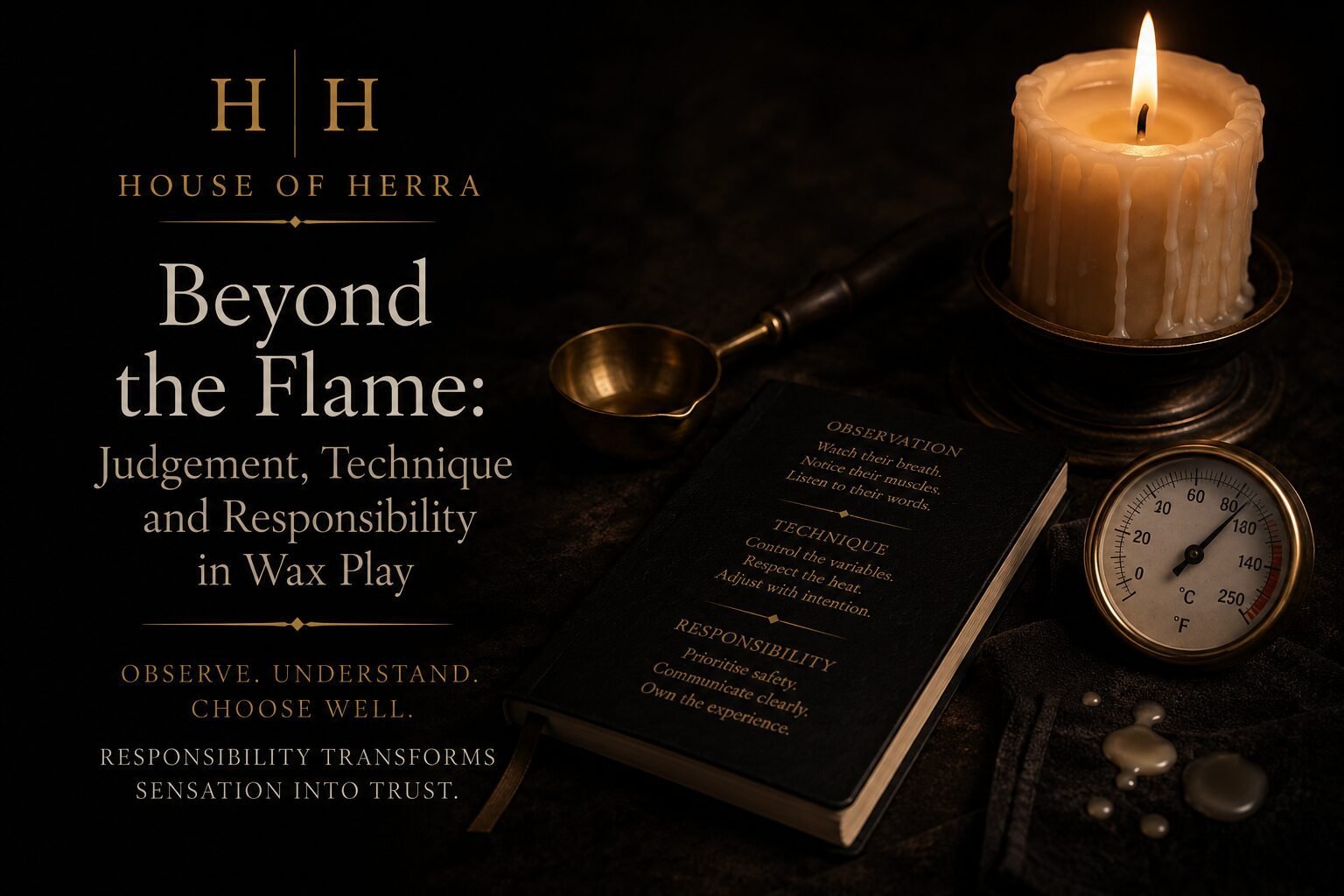
Beyond the Flame: Judgement, Technique and Responsibility in Wax Play
The Difference Between Knowing and Understanding
By the time someone becomes comfortable with wax play, an interesting change often begins to occur.
The mechanics become familiar.
Lighting the candle no longer feels novel. The first few drops no longer produce uncertainty. Equipment becomes routine. Cleanup becomes efficient. Conversations about body positioning, preparation and aftercare begin to happen almost automatically.
Confidence grows.
Confidence is valuable.
It is also where some of the most important lessons begin.
There is a subtle difference between becoming proficient at wax play and truly understanding it. Proficiency is the ability to repeat a successful scene. Understanding is recognising why that scene succeeded and, more importantly, recognising when the next one should be approached differently.
This distinction separates experience from wisdom.
Experience counts repetitions.
Wisdom notices variation.
That is why the final stage of learning wax play has surprisingly little to do with candles. Instead, it concerns observation, judgement and the quiet discipline of remaining curious even after many successful scenes.
Wax never stops teaching.
The question is whether we continue paying attention.
The Illusion of Predictability
Human beings naturally seek patterns.
If one candle behaves consistently over several scenes, we begin to expect it will continue doing so. If one technique produces an enjoyable response, we assume it will produce the same response next time.
Usually, it does.
Sometimes, it does not.
That uncertainty frustrates people who hope mastery will eventually eliminate unpredictability.
In reality, unpredictability is part of the discipline.
The same wax may behave differently in winter than it does in summer. Skin that welcomed strong sensation last month may respond very differently after illness, fatigue or emotional stress. A room filled with warm bodies at an event creates different conditions from a quiet evening at home.
Nothing dramatic has changed.
Everything has changed.
Experienced practitioners eventually stop asking, "What happened?"
Instead they ask, "What changed?"
The answer is rarely the candle alone.
Heat Does Not End When the Wax Lands
Many discussions about wax play focus on the moment the wax reaches the skin.
That moment certainly matters.
It is not, however, where the most interesting physics occurs.
Once liquid wax leaves the candle, it begins losing heat immediately. Yet it does not surrender all of that heat at once. Instead, the process unfolds over time as the wax cools and gradually returns from a liquid to a solid state.
During this transition, energy continues moving from the wax into the skin.
This is why the experience cannot be understood solely by considering the temperature at which the wax first arrives.
The behaviour that follows is equally important.
Some waxes cool and solidify quickly. Others remain soft for longer, maintaining close contact with the skin before finally setting.
That difference influences sensation far more than many people realise.
The receiver does not experience a single instant.
They experience the entire cooling process.
The Quiet Importance of Phase Transition
Although the terminology sounds technical, the underlying principle is surprisingly intuitive.
Every wax passes through a period where it is neither fully liquid nor completely solid. During this transition it gradually thickens, loses mobility and eventually becomes firm enough to peel away.
What matters is not simply that this happens.
What matters is how quickly it happens.
A wax that moves rapidly through this phase tends to end its contact with the skin sooner. One that remains soft and viscous continues transferring warmth while maintaining close contact.
Neither behaviour is inherently good or bad.
Each simply requires different judgement.
This explains why two candles with apparently similar melting points may feel entirely different during a scene.
Their behaviour after landing matters just as much as their behaviour before dripping.
Understanding this encourages a healthier mindset.
Instead of searching endlessly for the "perfect" wax, practitioners begin learning the personality of the waxes they already own.
Observation Becomes the Greatest Skill
There is a noticeable shift that occurs as practitioners gain experience.
Beginners watch the candle.
Experienced players watch the wax.
The most accomplished watch the person.
This progression is not accidental.
The candle merely produces molten wax.
The wax behaves according to its physical properties.
The receiver tells us whether those properties are creating the intended experience.
Observation therefore extends far beyond facial expressions.
Ask yourself:
- How quickly does the wax set?
- Does it remain glossy for several seconds before becoming opaque?
- Does it cling?
- Does it lift cleanly?
- Does it run in unexpected directions?
- Does the receiver appear increasingly relaxed or increasingly tense?
Every one of these observations becomes information.
Taken together, they allow small adjustments that dramatically improve both safety and enjoyment.
The best scenes rarely emerge from rigid planning.
They evolve through careful attention.
Intensity Is Not the Same as Quality
Within many areas of BDSM there exists an understandable temptation to equate greater intensity with greater achievement.
Wax play quietly resists this way of thinking.
A scene covered in elaborate layers of wax is not necessarily more successful than one involving only a handful of carefully placed drops.
Similarly, hotter wax is not inherently better.
Nor is colder wax inherently gentler.
Quality lies elsewhere.
It lies in intention.
Ask yourself:
- Was every decision made deliberately?
- Did the pace suit the receiver?
- Were adjustments made when circumstances changed?
- Did both people remain emotionally present throughout the experience?
If so, the quantity of wax becomes largely irrelevant.
Meaningful scenes are remembered because of how they made people feel, not because of how many candles were consumed.
Responsibility Is an Ongoing Practice
Authority is sometimes misunderstood as confidence without hesitation.
House of Herra has always taken a different view.
The strongest Dominants are distinguished not by certainty, but by responsibility.
Responsibility appears quietly.
It is visible in the candle tested before every scene despite having been used dozens of times before.
It appears in the towel placed nearby even though it is unlikely to be needed.
It appears in the willingness to pause without embarrassment when something feels different.
These actions rarely receive praise.
They should.
Because they reveal something important.
Responsible practitioners prepare for possibilities rather than assuming experience grants immunity from mistakes.
Preparation is not evidence of fear.
It is evidence of respect.
Learning the Person, Not the Technique
No two receivers experience wax in precisely the same way.
Some delight in anticipation.
Others enjoy the moment of contact itself.
Some appreciate rhythmic consistency.
Others prefer unpredictability.
There is no universal formula.
This is why experienced Dominants gradually shift their attention away from mastering techniques and towards understanding people.
A particular partner may enjoy cooler droplets released from greater height.
Another may prefer slower application from closer range.
Neither preference is objectively superior.
They are simply different conversations between different bodies.
Technique becomes meaningful only when adapted to the individual.
Without adaptation, even technically excellent wax play becomes strangely impersonal.
The Wisdom of Remaining a Beginner
Perhaps the greatest lesson wax play offers is humility.
After enough scenes, it becomes tempting to believe there is little left to learn.
Yet every experienced practitioner eventually encounters a candle that behaves unexpectedly, an environment that alters familiar techniques or a partner whose responses challenge comfortable assumptions.
These moments should not be viewed as setbacks.
They are reminders.
The body remains wonderfully complex.
Heat remains wonderfully complex.
Human relationships remain even more so.
Approaching each scene with the curiosity of a beginner while carrying the knowledge of experience may be the closest anyone comes to genuine mastery.
Not because beginners know little.
Because beginners are still willing to observe everything.
Conclusion
There is an irony at the heart of wax play.
The more we study the science, the more we discover that science alone is insufficient.
Physics explains how heat moves.
Chemistry explains how wax behaves.
Physiology explains how skin responds.
None of these explains trust.
None explains why one person willingly closes their eyes while another holds a lit candle above them.
That belongs to something entirely different.
It belongs to judgement.
To communication.
To responsibility.
To the quiet confidence earned through repeated acts of care.
In the end, wax play is not defined by temperature charts or candle labels.
Those things matter.
But they are tools.
The real practice begins when knowledge becomes observation, observation becomes understanding, and understanding becomes wisdom.
Perhaps that is the lesson every candle quietly teaches.
The flame captures our attention.
The wax delivers sensation.
Yet neither deserves the credit.
The true art has always belonged to the people holding the moment between them.
Suggested Readers Journey



0 Comments