
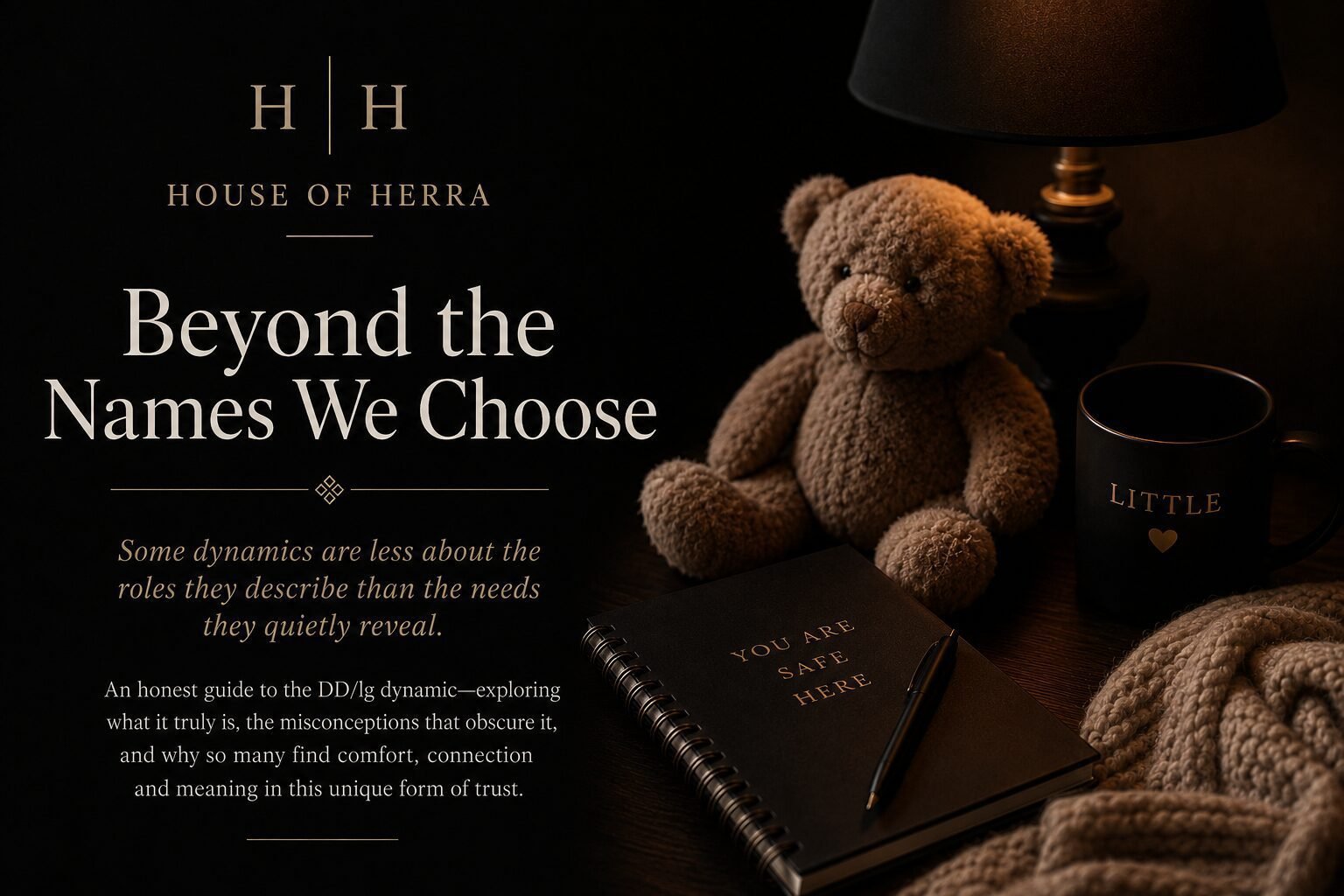
Beyond the Names We Choose
Some dynamics are less about the roles they describe than the needs they quietly reveal.
The Labels Invite Assumptions
There are certain words within BDSM that seem to invite misunderstanding before they invite curiosity. Few do so more reliably than Daddy Dom and little. Long before anyone has asked what they mean, assumptions have already filled the silence. The language alone is enough for some to dismiss the dynamic entirely, convinced they already understand it.
I've often found that to be one of the peculiar challenges of kink. The labels that appear most unusual from the outside frequently describe experiences that are deeply ordinary in human terms. Strip away the specialised language and what often remains are familiar desires: to feel safe, to be trusted, to care for another person, to rest for a while from the weight of adulthood.
Perhaps that is why so many people misunderstand DD/lg. They see the vocabulary but never reach the relationship beneath it.
Caregiver Dynamics Exist on a Spectrum
Like every power exchange, DD/lg exists on a spectrum rather than inside a definition. There is no single way to practise it, no universal set of rituals, and no checklist that determines whether someone belongs. Some relationships are playful. Others are deeply structured. Some are woven into everyday life, while others appear only during carefully negotiated scenes. Some include sexuality; many do not.
The common thread is not behaviour. It is intention.
Responsibility Must Be Negotiated
At its heart, DD/lg belongs within the wider family of caregiver dynamics. One partner consciously accepts greater responsibility for guidance, protection and emotional steadiness, while the other allows themselves the rare privilege of becoming cared for. That exchange of responsibility is deliberate, negotiated and consensual. Nothing is assumed. Nothing is taken.
The language of Daddy often attracts the greatest scrutiny, yet language inside relationships has always been symbolic rather than literal. Lovers have called one another baby, sir, angel, master, princess, and countless other names that describe emotional positions rather than biological realities. Within DD/lg, Daddy represents a style of leadership defined by patience, consistency and care far more than authority itself.
The title carries responsibility before it carries privilege. That distinction matters.
It is easy to mistake dominance for control. In reality, healthy dominance is often measured by restraint. The strongest Dominants I have known have rarely needed to remind anyone they were in charge. Their confidence rested in creating an environment where another person could finally stop performing competence and simply exist.
That is especially true within caregiver dynamics.
Many littles spend their professional lives making decisions, solving problems and carrying responsibilities that others depend upon. They are teachers, nurses, executives, parents, carers and business owners. From the outside they appear composed, capable and endlessly resilient.
Yet capability is not the absence of exhaustion.
There is something profoundly human about longing for a place where no one expects you to hold everything together.
Littlespace Can Offer Emotional Rest
For some, littlespace becomes exactly that.
The term often creates images of costumes or toys, yet these outward expressions are only one possible language among many. Littlespace is better understood as an emotional state—a place where adult responsibilities soften for a while, where vulnerability becomes easier to express, and where comfort replaces performance.
Some people colour intricate pictures. Some curl beneath blankets with a favourite plush toy. Some watch familiar films, read bedtime stories or enjoy simple routines that create feelings of security. Others never engage in any of those activities at all. What matters is not the appearance of the behaviour but the emotional function it serves.
There is an assumption that regression is about pretending to become someone else. My experience suggests something quieter. Often it is less about becoming childlike than about allowing parts of ourselves, long hidden beneath adulthood, to emerge without embarrassment. Curiosity. Wonder. Playfulness. Dependency. The willingness to ask for reassurance instead of pretending we do not need it.
Most adults have learned to disguise these needs remarkably well. DD/lg creates a relationship in which hiding them is no longer necessary.
Of course, vulnerability without safety quickly becomes dangerous. That is why consent occupies such a central place within caregiver dynamics. The gentleness people often associate with DD/lg does not reduce the need for negotiation. If anything, it increases it.
Emotional intimacy deserves every bit as much discussion as physical intimacy.
Boundaries remain boundaries
Safewords remain important, as do personal boundaries. Autonomy remains intact.
Healthy caregiver dynamics are built upon conversations that begin long before anyone adopts a title. They explore expectations, fears, responsibilities and limitations. They acknowledge that nurturing is not mind-reading and submission is not obligation.
The relationship succeeds not because two people perfectly understand one another, but because they continue choosing to understand one another better.
This is perhaps where outsiders sometimes become confused. From a distance, rules can appear restrictive. Inside a healthy relationship they often function quite differently. A reminder to drink water. An agreed bedtime. Medication prompts. Encouragement to eat properly. Checking that someone has arrived home safely. These are not demonstrations of ownership. They are expressions of care translated into routine.
Structure is rarely the point. The feeling of being cared for is.
There is also a quiet misconception that caregiver dynamics attract only emotionally fragile people searching for someone to rescue them. I've never found that particularly convincing. If anything, the opposite often appears true. People who spend their lives caring for others frequently long to experience being cared for themselves. Those who shoulder enormous responsibility sometimes crave environments where responsibility can briefly be shared. That longing does not indicate weakness. It reminds us that strength without rest eventually becomes loneliness.
Equally, becoming a Daddy Dom should never be mistaken for becoming someone's parent. The resemblance exists only in the language, not in the relationship. A responsible Daddy is not replacing adulthood. They are supporting another adult who has consciously chosen this particular form of intimacy. The distinction is essential because power without equality is never genuine power exchange. Every little retains agency. Every Daddy remains accountable.
Two Adults Keep Choosing the Relationship
The relationship exists because two adults continue choosing it together.
That choice may evolve over time. Some discover the dynamic becomes a permanent part of their relationship. Others find it appears only during particular moments of emotional need. Some eventually move away from it entirely. None of these outcomes represent failure.
Relationships are living things. They grow, adapt and sometimes outgrow the language that first brought them together.
Perhaps the greatest lesson DD/lg offers extends beyond kink altogether.
Modern adulthood quietly encourages relentless self-sufficiency. We celebrate independence, productivity and resilience so enthusiastically that dependence begins to feel like failure. Yet every meaningful relationship eventually asks us to do something profoundly difficult.
To trust another person with the parts of ourselves that cannot remain strong forever. Sometimes that trust appears through conversation. Sometimes through silence. Sometimes through carefully negotiated power exchange. Sometimes through a simple question asked at the end of a difficult day. "Have you eaten?"
In another relationship, those words might pass unnoticed. Within a caregiver dynamic, they can carry extraordinary meaning. Not because someone has surrendered their independence. But because, for a little while, someone else has chosen to help carry its weight.
Perhaps that is what DD/lg has always been about. Not the titles people use, nor the rituals they create, but the rare comfort of discovering that intimacy is sometimes found not in becoming less of an adult, but in finding someone with whom adulthood no longer has to be carried alone.
Suggested Readers Journey
Read Before
Read Next
Read Afterwards
An article about Littlespace can be found here by littlebabyboonursery