
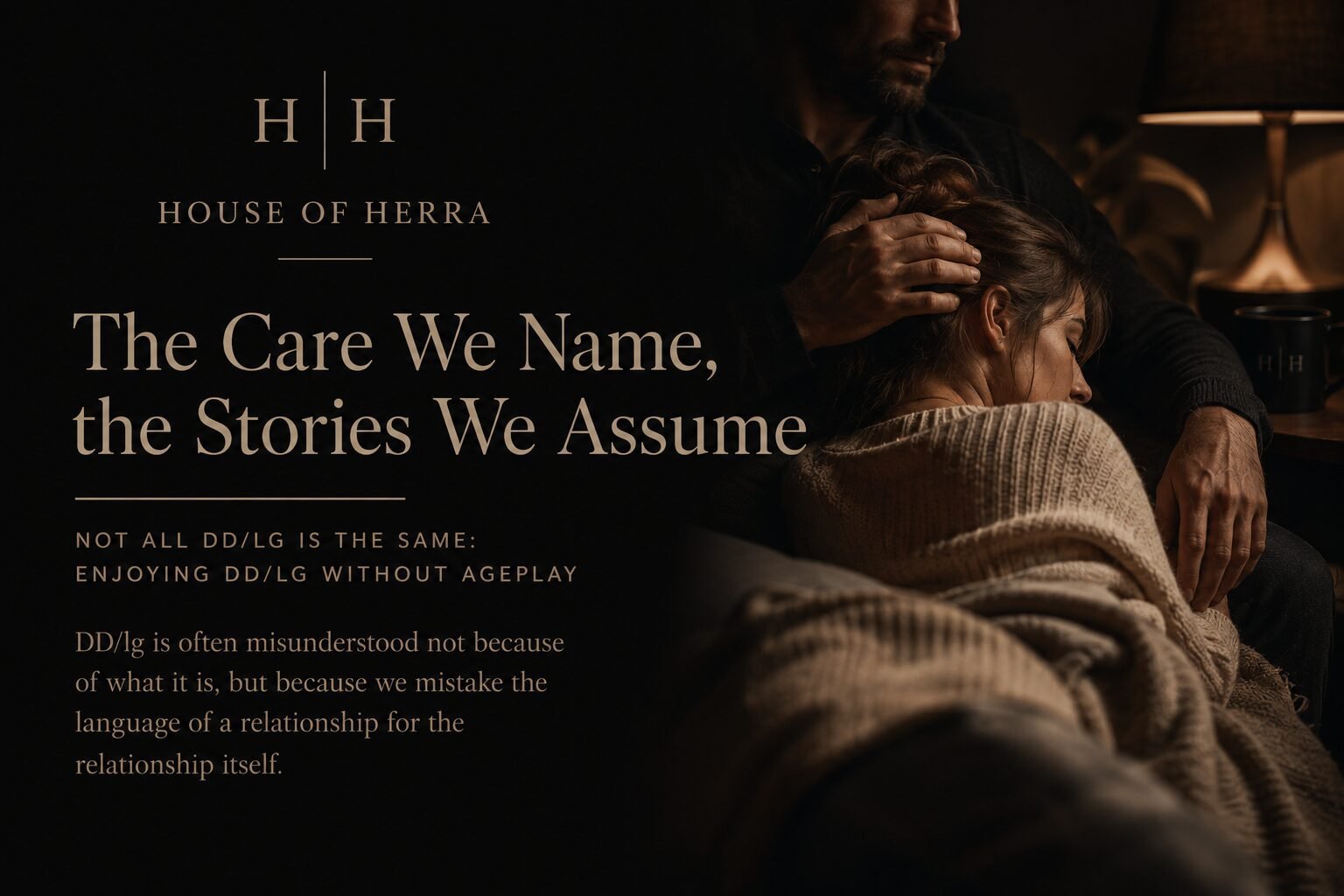
The Care We Name, the Stories We Assume
DD/lg is often misunderstood not because of what it is, but because we mistake the language of a relationship for the relationship itself.
There is something quietly revealing about the way we respond to names.
Long before we understand what a relationship looks like, we often decide what we think about it simply because of the words attached to it. A title becomes a story. A label becomes an assumption. We stop looking at the people involved and begin reacting to the images the language has already created in our minds.
Few dynamics within BDSM demonstrate this more clearly than DD/lg.
Mention the initials in conversation and many people immediately picture the same familiar scene: pastel clothing, stuffed animals, colouring books, baby talk and deliberate age regression. For some, that image is deeply comforting. For others, it feels uncomfortable or entirely incompatible with what they seek from power exchange.
What often goes unnoticed is that neither reaction tells us very much about DD/lg itself. It tells us far more about the stories we have learned to associate with the language. I've come to realise that one of the greatest challenges within kink is not explaining practices. It is separating practices from assumptions. We often inherit definitions before we've ever met the people living them.
At its heart, DD/lg is simply one expression of consensual power exchange. Like every healthy D/s relationship, it is built upon negotiation, trust, communication and the willingness of two people to create something that belongs uniquely to them. Everything else is optional.
That last sentence is worth lingering over because it challenges one of the most persistent misunderstandings surrounding the dynamic.
DD/lg Beyond Ageplay
Ageplay is not synonymous with DD/lg. For some couples it is an important and fulfilling part of their relationship. It offers comfort, emotional release, playfulness or a carefully negotiated form of psychological exploration. There is nothing inherently wrong with that when it exists between informed, consenting adults.
But for many others, ageplay is absent altogether. What remains is something quieter. Something that is less about pretending to be younger and more about allowing oneself to be softer. The distinction matters. Vulnerability is not childhood. Needing reassurance is not immaturity. Enjoying protection is not regression.
Most of us, regardless of our roles within BDSM, spend much of our lives being capable. We solve problems. We make decisions. We carry responsibilities that leave very little room to simply be looked after. Strength becomes habitual until we almost forget that it is exhausting. Perhaps that is why so many people are drawn towards dynamics centred on care.
Not because they wish to become someone else. Because they are searching for somewhere they no longer need to carry everything alone.
Understanding Caregiver Dominance
The language of "Daddy" often confuses people because it is interpreted literally rather than relationally. Within many relationships, the title has remarkably little to do with fatherhood. Instead, it has become shorthand for a particular style of dominance. One that values steadiness over intimidation. Guidance over command. Protection over performance. It describes emotional posture more than social role.
The same is true of the word "little." Outside the community, it is often heard as meaning childlike. Within many relationships, it means something entirely different. It can describe a state in which emotional defences soften. A willingness to trust. A desire to receive care without immediately feeling obligated to reciprocate. A moment when achievement, competence and independence are allowed to rest for a while. There is nothing inherently childish about any of that. In truth, it requires considerable emotional maturity to trust another person enough to become vulnerable in their presence.
That is why I find the healthiest DD/lg relationships are rarely defined by props or rituals. They are defined by consistency. A quiet message asking whether someone has eaten today. A reminder to drink water before the headache begins. A gentle insistence on getting enough sleep. The familiar comfort of knowing someone notices when your voice changes before you do. None of these things are particularly dramatic. Yet they speak fluently in the language of care.
Sometimes dominance looks remarkably ordinary.
Authority Built Through Care
We spend a great deal of time within BDSM discussing control, but not nearly enough discussing responsibility. Any Dominant can create rules. Far fewer learn how to create safety. There is an important difference.
Rules without care become management. Authority without empathy becomes performance. Control without attentiveness quickly loses sight of the person it claims to lead.
Caregiver dynamics remind us that authority is not measured by how effectively someone directs another's behaviour. It is measured by how faithfully they protect the trust that behaviour represents.
That changes everything. Because suddenly obedience is no longer the point. Connection is. The rituals themselves become secondary. A bedtime check-in. Morning messages. Shared routines. Praise offered sincerely. Gentle correction delivered without humiliation. These practices matter not because they follow a recognised DD/lg template, but because they communicate something deeper. "I see you." "I notice you." "You are safe enough here to stop pretending that you have everything under control."
Labels Are Not Relationships
Perhaps that is why conversations about DD/lg often become tangled so quickly.
People assume they are debating one dynamic when, in reality, they are discussing entirely different relationships that happen to share similar terminology. One couple may embrace age regression as a meaningful part of their intimacy. Another may find that idea completely incompatible with what they seek. Neither invalidates the other. Both become problematic only when they assume their version is the definition.
I've often thought that one of the healthiest habits in kink is learning to ask better questions before forming opinions. "What does this word mean to you?" "How does this dynamic make you feel?" "What role does it play in your relationship?"
These questions reveal far more than assumptions ever will.
Language, after all, is only a map. Relationships are the landscape.
Negotiating Shared Meaning
This is why negotiation remains so important. Not simply because BDSM involves risk, but because words carry different emotional meanings for different people. One person's comforting ritual may be another person's uncomfortable boundary. One person's affectionate title may evoke entirely different emotions in someone else. Healthy dynamics are not built by adopting labels. They are built by translating them together. When two people carefully define what their relationship means to them, they create something that no internet definition could ever fully describe. That conversation is far more intimate than any protocol.
It asks for honesty before obedience. Curiosity before certainty. Understanding before expectation. Those qualities sustain relationships long after novelty has faded.
The Quiet Language of Care
In the end, I suspect the appeal of non-ageplay DD/lg has very little to do with the letters themselves. It reflects a quieter human longing. To be cared for without having to earn it. To be guided without being diminished. To be protected without surrendering dignity. To discover that strength and softness were never opposites in the first place.
Perhaps that is why these dynamics continue to resonate with so many people, even when they choose to leave ageplay entirely outside the relationship. They remind us that power does not always speak loudly. Sometimes it asks whether you've eaten. Sometimes it notices you're carrying too much before you admit it yourself. And sometimes the most profound expression of dominance is not found in control at all, but in the simple, unwavering decision to become a place where another person can safely put the weight of the world down for a while.