
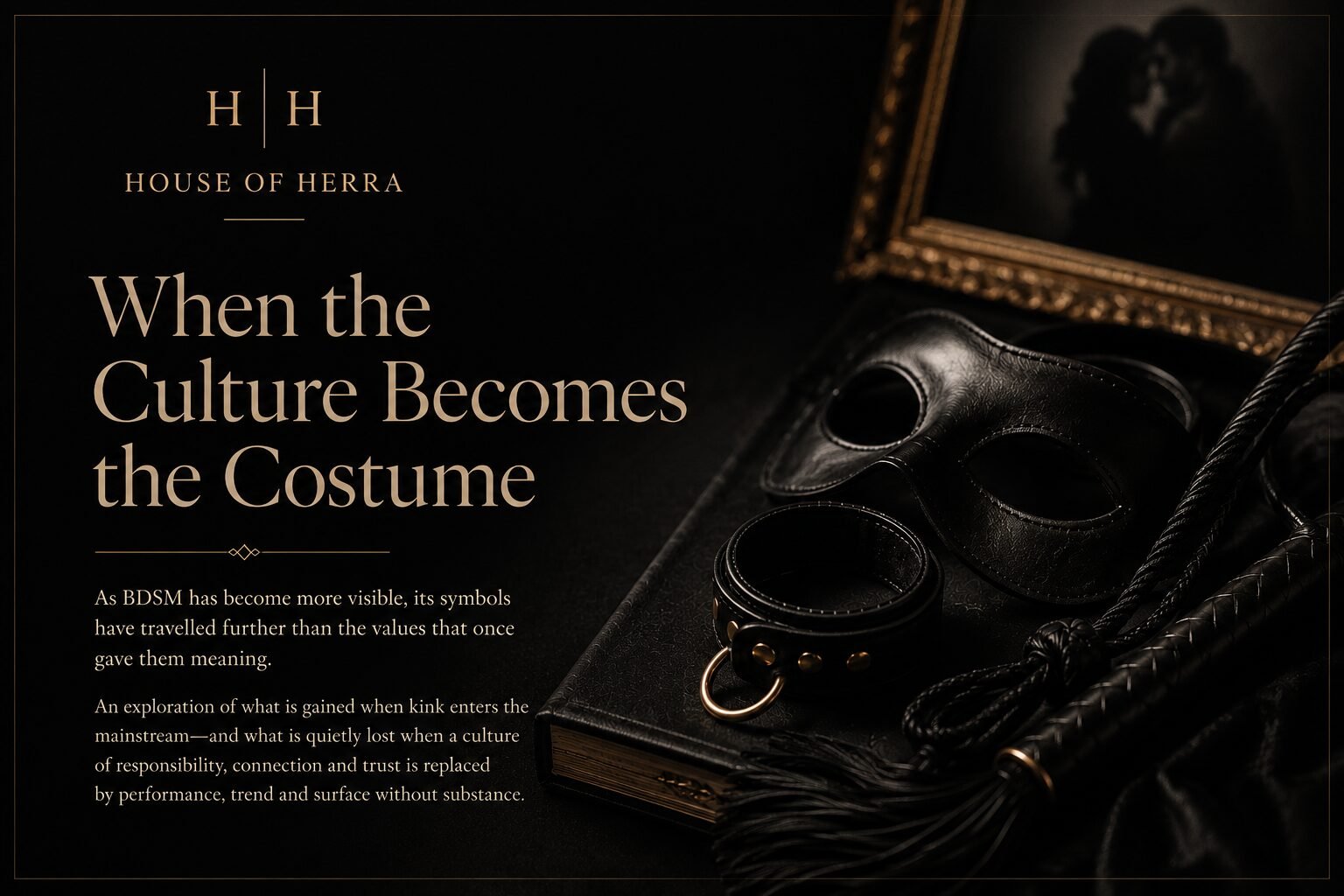
When the Culture Becomes the Costume
As BDSM has become more visible, its symbols have travelled further than the values that once gave them meaning.
There is something quietly paradoxical about progress. We spend years hoping that something once hidden will be understood, only to discover that understanding and visibility are not always the same thing.
When I first found my way into the BDSM community, it felt less like entering a scene and more like joining a conversation that had already been taking place for decades. Nobody handed you an identity on your first day. You arrived cautiously, asked questions, listened more than you spoke, and gradually earned your place through curiosity, respect and patience. There was no expectation that you already knew who you were. In many ways, not knowing was considered a strength, because it left room to learn.
That world was never perfect. It could be insular. It could be intimidating. Like any community, it contained its share of difficult personalities and flawed ideas. Yet beneath all of that was an understanding that BDSM was never simply about what people did to one another. It was about why they did it, how they did it, and the responsibilities they accepted in choosing to explore power together.
Looking back, I realise that this was what gave the community its centre of gravity.
Visibility Without Understanding
Today, the landscape looks very different.
The internet has transformed almost every aspect of human connection, and kink has not been immune to that change. Information that once required books, workshops or trusted mentors now sits a few keystrokes away. Someone questioning their desires no longer has to wonder whether they are alone. They can discover language for experiences they have never been able to describe, find communities that reflect their interests, and begin exploring parts of themselves that may have remained hidden for years.
That is no small thing.
For many people, visibility has brought relief. It has reduced shame. It has made conversations about consent, identity and alternative relationships far more accessible than they once were. During the isolation of the pandemic, many people found themselves examining desires they had previously kept buried beneath routine and expectation. Curiosity flourished, and with it came an entirely new generation entering the world of BDSM.
I would never wish to return to a time when people felt isolated by their curiosity.
But accessibility carries its own consequences.
Every culture develops through shared values as much as shared interests. When a community grows rapidly, those values are not always passed on at the same pace as its popularity.
That, I think, is what I notice most today.
Symbols Without Context
Kink has become visible in ways I could scarcely have imagined years ago. Its language appears in mainstream media. Its aesthetics influence fashion. Social media platforms are filled with carefully curated photographs, dramatic captions and bite-sized lessons on dominance and submission. In many respects, BDSM has become culturally recognisable.
Recognition, however, is not the same as understanding.
The internet excels at transmitting images. It struggles to communicate context. A photograph can show a collar.
Perhaps nowhere is this more apparent than in the growing confusion between kink and power exchange.
Yet they are where genuine authority is earned.
When Performance Replaces Practice
I sometimes meet people who can describe every type of whip, every protocol and every title, yet struggle to talk about emotional responsibility. They know the vocabulary of BDSM before they understand the weight of the words themselves.
That is not a criticism of newcomers.
Knowledge tells us what something is.
Algorithms naturally reward certainty. They favour decisive statements over thoughtful questions, performance over nuance and confidence over reflection. Complexity is difficult to package into thirty seconds of content, so complexity is often discarded altogether.
What quietly disappears beneath those simplified images are the qualities that make power exchange meaningful in the first place.
The Heart of Ethical Dominance
The willingness to know another person deeply enough that authority becomes an act of stewardship rather than ownership.
I have come to realise that genuine dominance becomes less performative with experience, not more.
Ironically, very little of this appears particularly dominant to an outside observer.
That, to me, has always been the heart of ethical dominance.
That culture reminded us that consent is more than permission.
Preserving Culture Through Memory
I sometimes wonder whether what has been lost is not etiquette itself, but memory.
Communities develop traditions because those traditions preserve hard-earned lessons. When those traditions disappear, each generation risks repeating mistakes that previous generations had already learned to avoid.
If BDSM is to continue becoming more visible, then perhaps visibility alone cannot be our measure of success.
The internet can introduce someone to kink in an afternoon.
And perhaps that is reassuring.
The Work That Remains Human
Trends will continue to change. Platforms will rise and disappear. New aesthetics will replace old ones, and each generation will reshape the culture in ways the last could never have predicted.
But meaningful power exchange has never depended on popularity.
It has always depended on two people willing to meet one another with honesty, humility and care.
Everything else has simply been the scenery.