
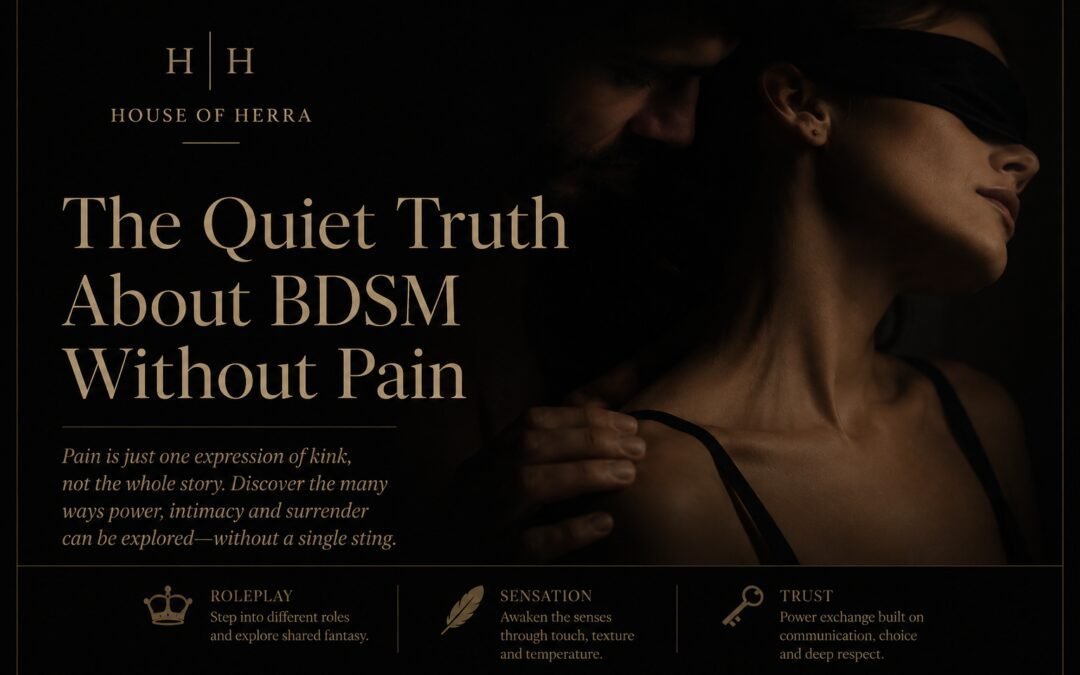
When people speak of pain as though it defines BDSM, they often overlook the quieter forms of intensity that leave no marks at all.
The first thing many people ask when they discover an interest in BDSM is whether it has to hurt.
It is an understandable question. Popular culture has spent decades reducing an extraordinarily broad landscape of human experience to a handful of familiar images: leather, whips, restraints and bruises. It is a language of spectacle because spectacle is easy to recognise. The quieter moments are harder to capture. They do not photograph as well. They rarely make headlines. Yet they are often where the deepest experiences are found.
I've come to realise that pain is perhaps the most misunderstood part of BDSM—not because it is unimportant, but because it is so often mistaken for its purpose.
Pain is simply one possible language among many.
For some, it is a language that speaks profoundly. It becomes a means of focus, release, catharsis or intimacy. For others, it holds no attraction whatsoever. Neither experience is more authentic than the other. Both are simply different ways of exploring trust, vulnerability and connection.
What matters is not whether pain is present.
What matters is why we are there in the first place.
At its heart, BDSM is less about what people do than about what they create together. It is an intentional exchange of trust. A conversation conducted through actions rather than words. An agreement that says, "For this moment, we will explore something together that neither of us could experience alone."
Pain can certainly exist within that conversation.
It does not define it.
This becomes clearer when we stop looking at BDSM as a collection of activities and begin looking at it as a collection of relationships. The implements disappear into the background, and what remains are two people negotiating vulnerability with unusual honesty.
That honesty can take many forms.
Sometimes it begins with imagination.
Roleplay has always fascinated me because it reveals how willing we are to step outside ourselves when we feel safe enough to do so. We slip into different identities—not because we wish to escape who we are, but because pretending often gives us permission to reveal truths we struggle to express directly.
The authority of a headmistress. The confidence of a knight. The composure of a butler. The vulnerability of a patient. None of these characters exist simply for theatrical amusement. They allow us to explore questions of power, responsibility, obedience and desire from a place of emotional safety.
The excitement comes not from convincing acting, but from shared belief.
For a little while, two people agree to inhabit another reality together.
That agreement can feel remarkably intimate.
Equally powerful is the world of sensation.
People often imagine sensation play as a gentler version of pain, but I think that misunderstands its purpose. Sensation is not merely pain with the volume turned down. It is curiosity made physical.
A feather drifting across bare skin.
The cool surprise of ice.
Warm breath against the neck.
The silence that follows a blindfold being tied.
Each removes certainty. Each asks the body to pay closer attention. When one sense is limited, another begins to speak more loudly. Ordinary touch becomes extraordinary simply because anticipation has changed the way it is received.
There is a lesson hidden here that extends well beyond BDSM.
Intensity does not always come from increasing force.
Sometimes it comes from increasing awareness.
Perhaps nowhere is this more evident than within dominance and submission themselves.
To those standing outside the lifestyle, dominance often appears physical. It is imagined as control enforced through strength or restraint. Yet in my experience, physical control is often the least interesting part.
The most profound moments are psychological.
A quiet instruction.
A sustained glance.
The deliberate choice to kneel.
The simple act of asking permission.
None of these require pain.
Yet each can carry extraordinary emotional weight because they represent something willingly offered rather than taken. Submission is not measured by what someone endures. It is measured by what they choose to entrust to another person.
Likewise, dominance is not demonstrated through force.
It is demonstrated through stewardship.
Anyone can issue commands.
Far fewer understand the responsibility that comes with having another person's trust placed gently into their hands.
That responsibility often appears in the smallest moments.
Checking in without breaking the atmosphere.
Recognising hesitation before words appear.
Knowing when to continue and when to stop.
Understanding that genuine authority rarely needs to raise its voice.
These are skills that leave no visible marks, yet they define the quality of every dynamic.
The same is true of restraint.
It is easy to assume bondage is about being unable to move.
I have always thought it is more interesting to ask what stillness allows us to feel.
When movement disappears, awareness often expands. Time changes its rhythm. The body notices things it normally ignores. A hand resting lightly against a shoulder can feel impossibly significant simply because there is nowhere else for attention to go.
The vulnerability created by restraint has very little to do with rope itself.
It has everything to do with trust.
The rope merely gives that trust a physical shape.
Then there are the rituals.
These rarely appear in conversations about BDSM because they seem almost too ordinary. Yet they may be among the most meaningful expressions of power exchange.
Preparing a collar before an evening together.
Greeting one another in a particular way.
Pouring a drink without being asked.
Sharing a period of quiet reflection after a scene.
Following routines that only the two of you understand.
None of these acts are dramatic. Most would pass unnoticed by anyone else. Yet repetition transforms them into something quietly profound. Rituals remind us that power exchange is not sustained through intensity alone. It is sustained through attention.
They say, in countless small ways, "I see you."
For many people, these moments become the relationship itself.
This is why I sometimes hesitate when newcomers ask whether BDSM is right for them because they dislike pain.
The question is built upon an assumption that may never have been true.
They are not really asking about pain.
They are asking whether they are allowed to explore power, trust, vulnerability and intimacy in ways that feel authentic to them.
The answer is yes.
Always yes.
There is no hierarchy that places one expression of BDSM above another. There is no invisible examination that determines whether someone is "kinky enough." The person who finds fulfilment in elaborate impact scenes and the person who finds it in nothing more than quiet rituals of service are exploring the same landscape through different paths.
Neither invalidates the other.
In fact, the diversity of those paths may be one of the community's greatest strengths.
It reminds us that BDSM has never truly been about pain.
It has always been about permission.
Permission to communicate differently.
Permission to trust more deliberately.
Permission to become vulnerable without shame.
Permission to discover aspects of ourselves that everyday life rarely invites us to explore.
Pain may be part of that journey for some people.
For many others, it never needs to be.
The older I become, the less interested I am in defining BDSM by the things people do. I find myself far more interested in the qualities those experiences reveal—patience, attentiveness, generosity, courage and care.
The implements may change.
The rituals may evolve.
The dynamics may deepen or soften over time.
But beneath them all remains the same quiet truth: the most powerful experiences are rarely created by pain alone. They are created by two people who choose, with remarkable intention, to trust one another enough to discover what intimacy can become when it is built on consent rather than assumption.
And that, perhaps, has never needed to hurt at all.


Recent Comments