
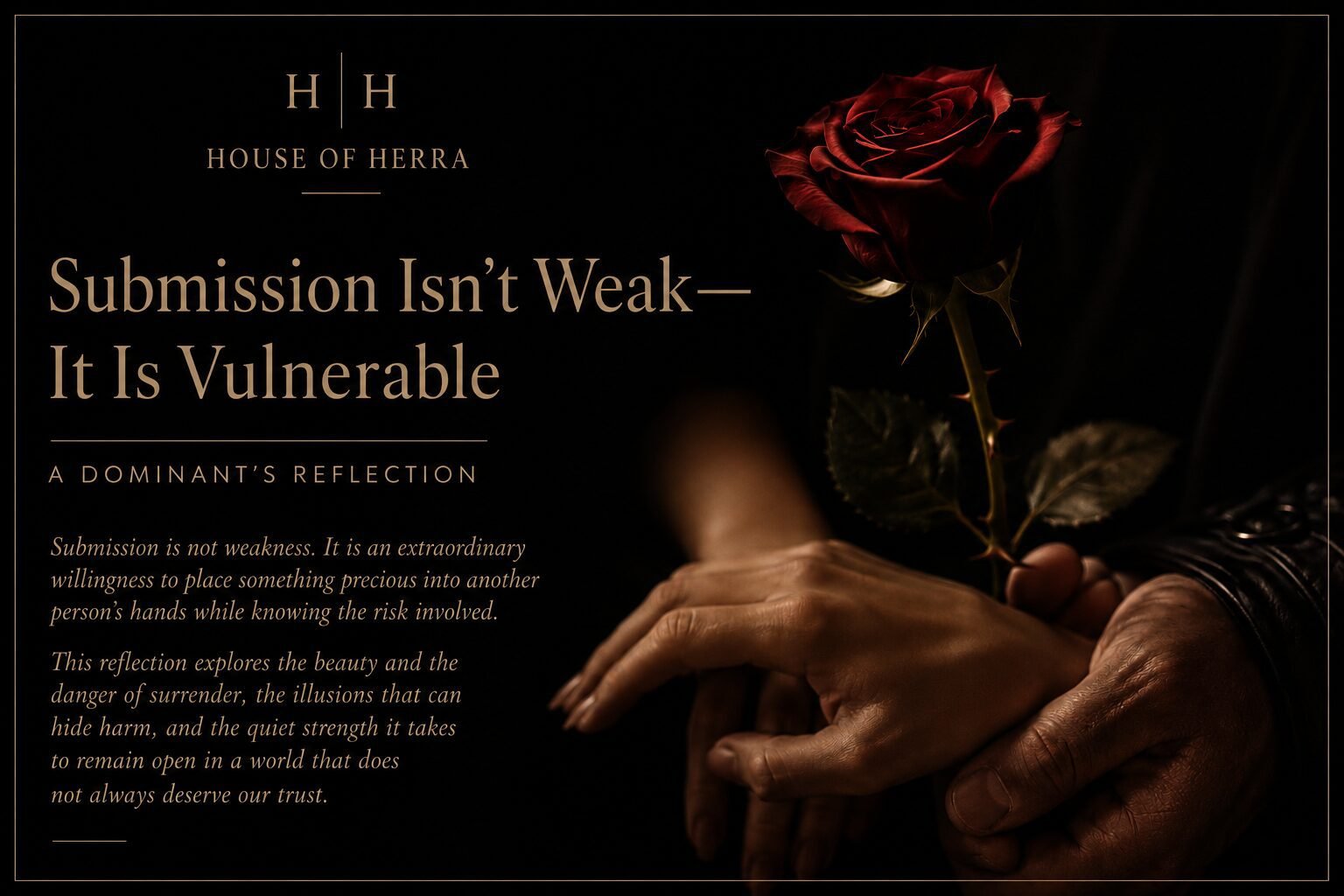
Submission Isn't Weak, It Is Vulnerable
The greatest strength in submission is not surrender itself, but the courage to remain open in a world that does not always deserve it.
There is a moment I have noticed in many submissives that rarely makes its way into conversations about power exchange. It often appears before a collar is fastened, before a command is given, before trust has had time to grow. It is almost imperceptible: a quick joke, a flash of defiance, a carefully practised confidence that seems determined to prove one thing above all else.
"I am not easy to hurt."
I have come to recognise that moment because I have seen it often enough, and because, in different ways, I have recognised it in myself.
For all the stereotypes that surround submission, one has always unsettled me more than the others. It is the idea that submissive people are naturally weak—fragile souls waiting for someone stronger to guide them through life. It is an image that strips people of their complexity before a dynamic has even begun.
My experience has been almost the opposite.
Some of the strongest people I have ever known have identified as submissive. They lead businesses, raise families, challenge authority, make difficult decisions and carry extraordinary responsibilities. Their submission has never diminished those qualities. If anything, it has required them to understand themselves more deeply than many people ever do.
Strength and submission have never been opposites.
Yet neither should we pretend that submission carries no particular vulnerability.
That is where the conversation becomes uncomfortable.
Submission asks someone to make themselves emotionally visible. It is an invitation to trust another person with parts of ourselves that are usually kept hidden from the rest of the world. Sometimes that trust concerns a single scene. Sometimes it grows into daily rituals, shared decisions and lives woven quietly together. Whatever form it takes, submission is never merely about obedience. It is about allowing another person meaningful influence over your emotional landscape.
That is a remarkable gift.
It is also one that can be misused.
Perhaps this is why healthy dominance has never felt powerful to me in the way many people imagine. At its best, dominance feels less like taking control and more like becoming a place where another person can safely place their trust. It creates space rather than consumes it. It protects rather than possesses. It understands that authority exists because someone has chosen to grant it, not because it has been taken.
Healthy dominance should feel expansive.
Unhealthy dominance often feels exactly the same at first.
That is the difficulty.
People often imagine dangerous Dominants as obviously cruel, aggressive or manipulative. Life is rarely so generous with its warnings. The people capable of causing the deepest harm are often remarkably convincing. They speak fluently about consent. They understand community language. They present themselves as mentors, protectors or experienced guides. They know precisely which words create confidence because they have learned what people long to hear.
Predatory behaviour is rarely introduced through fear.
More often, it arrives wrapped in reassurance.
It asks for trust before it has earned it.
It encourages dependence before genuine intimacy has developed.
It slowly replaces dialogue with certainty until questioning begins to feel like disobedience rather than healthy curiosity.
None of this happens overnight. If it did, few people would remain.
Manipulation is patient.
That is why experience alone offers no guarantee of safety.
I have known submissives with decades of experience who have still found themselves questioning their instincts after encountering someone skilled at emotional manipulation. I have known Dominants who believed they could always recognise abusive behaviour until they found themselves deceived by someone whose confidence exceeded their integrity.
Knowledge helps.
Community helps.
Good communication helps.
None of them eliminate risk.
Power exchange is unlike many other relationships because it deliberately invites asymmetry. We choose to explore trust by handing another person influence that would ordinarily remain our own. That is precisely what makes the dynamic beautiful, but it is also what makes it uniquely demanding of honesty, patience and responsibility.
Sometimes I think of submission as walking through a rose garden.
People notice the flowers first. They speak about beauty, connection, devotion and intimacy, and rightly so. Those things deserve celebration. There are moments within D/s that possess a depth of understanding difficult to describe to anyone who has never experienced them. They can reshape how we understand ourselves and one another.
But every rose grows beside thorns.
Pretending otherwise does not make the garden safer.
It merely leaves people surprised when they bleed.
I occasionally hear submissives wonder whether life might simply be easier if they stopped pursuing power exchange altogether. Whether it would be simpler to seek conventional relationships where these questions of authority, surrender and vulnerability never arise.
It is an understandable thought.
Fear often makes simplicity seem attractive.
Yet many of the people who ask that question eventually discover something quietly frustrating.
Submission is not merely something they practise.
It is something they recognise within themselves.
Even outside explicitly kinky relationships, familiar patterns begin to emerge. They naturally seek trust, service, emotional leadership or the comfort of giving themselves wholeheartedly to someone they believe deserves it. The labels may disappear, but the underlying dynamic often remains.
That does not mean everyone is submissive.
Nor does it mean submission is inevitable.
It simply reminds us that, for some people, this is less a hobby than a language through which they naturally experience intimacy.
If that is true, then asking someone never to submit can feel rather like asking them never to love deeply because heartbreak exists.
The danger is real.
So is the longing.
Neither cancels the other.
Perhaps this is where strength reveals itself most clearly.
Not in enduring pain.
Not in unquestioning obedience.
Not even in kneeling.
The real courage of submission lies in remaining emotionally open despite knowing exactly what openness can cost.
That is a different kind of bravery from the one our culture usually celebrates. We often admire those who become harder after disappointment, who build thicker walls after betrayal and learn never to trust so completely again.
Submission quietly asks a different question.
What if wisdom does not always look like becoming harder?
What if sometimes it means becoming more discerning while refusing to become closed?
There is an important distinction between vulnerability and naivety. One chooses openness with awareness. The other mistakes hope for evidence. Healthy submission requires the first and learns, often painfully, to avoid the second.
That is why I believe our communities should spend less time teaching people how to submit beautifully and more time teaching them how to recognise healthy leadership, how to trust their discomfort, how to leave without guilt and how to understand that withdrawing consent is never a failure.
Likewise, we should spend less time celebrating authority and more time examining responsibility.
Because power is easy to admire.
Character takes much longer to discover.
Over the years I have become less interested in finding perfect Dominants or perfect submissives. I no longer think such people exist. What interests me now are those who remain curious about themselves, who question their assumptions, who apologise when they are wrong and who understand that trust is something renewed continuously rather than earned once.
Perhaps that is the quiet work beneath every meaningful D/s relationship.
Not becoming fearless.
But learning which fears deserve our attention and which should not prevent us from loving well.
Submission is not weakness.
It never was.
It is an extraordinary willingness to place something precious into another person's hands while knowing those hands belong to another human being—capable of tenderness, capable of error, and always deserving of careful observation before they are trusted.
Perhaps that is why the rose garden continues to call so many people back.
Not because it promises a life without thorns, but because, despite them, the flowers remain worth walking slowly enough to truly see.