
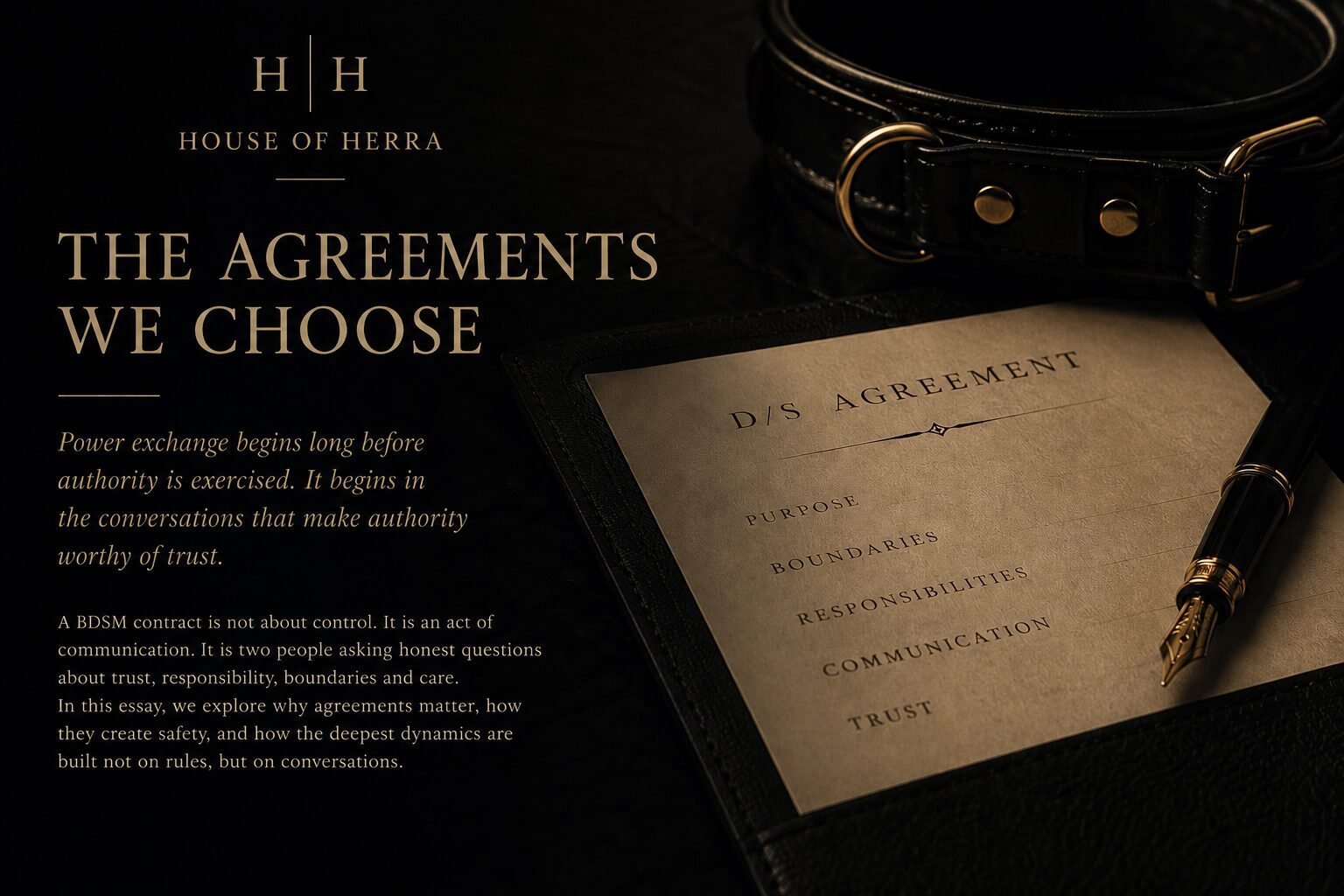
The Agreements We Choose
Power exchange begins long before authority is exercised. It begins in the conversations that make authority worthy of trust.
There is something quietly revealing about watching two people negotiate the shape of a relationship.
Not because of the rules they settle on, nor the rituals they choose to share, but because of the questions they ask one another. Those conversations often tell me far more about the health of a dynamic than anything that happens after a collar is fastened or a scene begins.
The way we negotiate exposes what we believe power is for.
For some, authority is imagined as something bestowed in a single moment—a title claimed, a collar accepted, a promise spoken. Yet the longer I have spent within BDSM, the less convincing that idea has become. Power exchange rarely begins with power. It begins with communication.
That is why I have always found contracts fascinating.
Not because they create a relationship, but because they reveal one.
Too often, the idea of a BDSM contract has been reduced to theatre. Popular culture imagines elaborate legal documents, pages of clauses, signatures beneath impossible promises and the illusion that intimacy can somehow be governed by paperwork. It makes for dramatic storytelling, but it misses the point entirely.
A contract is not a legal instrument.
It is an act of conversation.
At its best, it is simply two people sitting together long enough to ask questions that many couples, inside or outside BDSM, never think to ask at all.
What are we trying to build?
What do we need from one another?
What are we afraid of?
How will we know when something isn't working?
Those questions matter far more than the document that eventually contains the answers.
I have written several contracts over the years. None of them have remained unchanged. Every one reflected who we were at that particular moment rather than who we imagined we would become.
That, perhaps, is their greatest strength.
A contract should never be mistaken for permanence.
Relationships evolve because people evolve. Trust deepens. Confidence grows. Limits change. New vulnerabilities emerge. What once felt unimaginable gradually becomes ordinary, while rules that once seemed essential quietly disappear because they are no longer needed.
A good contract grows alongside the relationship.
A poor one attempts to freeze it in place.
There is an understandable temptation, particularly for newer Dominants, to see a contract as a declaration of authority. A long list of protocols can feel reassuring. Detailed rules create the impression of structure. Pages filled with expectations seem to promise certainty.
Yet structure is not measured by the number of rules.
It is measured by whether those rules serve the people living within them.
I have occasionally seen contracts that devote pages to what a submissive must do while offering almost nothing about what the Dominant owes in return. They describe obedience in remarkable detail but remain strangely silent about responsibility.
That imbalance tells its own story.
Authority without accountability is not leadership.
Within any meaningful power exchange, the Dominant accepts obligations every bit as significant as those undertaken by the submissive. To lead someone requires consistency. It requires emotional regulation. It requires patience when things become difficult, humility when mistakes are made, and enough self-awareness to recognise when one's own judgement is clouded.
Power creates responsibility long before it creates privilege.
Perhaps that is why I increasingly think of contracts less as lists of rules and more as shared declarations of responsibility.
The submissive may agree to protocols, rituals or behavioural expectations.
The Dominant agrees to create an environment where those expectations remain safe, proportionate and meaningful.
Neither commitment exists without the other.
This is where contracts become unexpectedly human.
They force us to speak aloud assumptions that might otherwise remain invisible.
What does aftercare actually look like?
How should conflict be handled?
When does the dynamic pause?
How do we distinguish playful correction from genuine discipline?
Who do we become when one of us is struggling outside the dynamic?
These are not administrative questions.
They are questions about trust.
Many of the strongest dynamics I have witnessed contain remarkably few rules. Instead, they possess extraordinary clarity.
Each person understands not only what is expected but why those expectations exist.
Purpose changes everything.
A bedtime ritual is no longer simply a routine. It becomes an opportunity for reassurance.
A morning greeting ceases to be protocol for protocol's sake. It becomes a daily acknowledgement that someone has chosen this relationship again.
Even something as simple as requesting permission carries meaning only when both people understand the emotional intention beneath it.
Without purpose, rules become bureaucracy.
With purpose, they become rituals of connection.
This is also why I encourage restraint at the beginning of a new dynamic.
Submission is not strengthened by overwhelming someone with dozens of expectations in the first week. Nor is Dominance demonstrated by inventing increasingly elaborate systems of control.
Relationships are learned gradually.
Habits become sustainable through repetition, not intensity.
Trust rarely arrives in dramatic moments. More often, it accumulates quietly through consistency.
A promise kept.
A boundary respected.
A difficult conversation handled with kindness instead of defensiveness.
These moments build something no document can create on its own.
Confidence.
It is confidence, rather than obligation, that eventually allows surrender to deepen.
One of the most overlooked sections of any contract is communication.
That omission has always puzzled me.
Power exchange often gives the impression that communication becomes less important once roles have been established. In reality, the opposite is true.
The more authority one person holds, the more carefully both people must communicate.
Silence has ended more dynamics than disagreement ever has.
Weekly check-ins. Honest conversations after scenes. The ability to suspend the dynamic long enough to speak as equals when something feels wrong. These are not interruptions to power exchange.
They are what allow power exchange to survive.
No protocol is strengthened by avoiding uncomfortable conversations.
No Dominant becomes more respected by becoming less approachable.
No submissive becomes safer by believing they must remain silent in order to appear devoted.
Communication is not separate from authority.
It is one of its highest expressions.
None of this requires a formal written contract, of course.
Many deeply fulfilling relationships exist without one.
Others consist of little more than a handful of shared understandings and the trust to honour them.
The document itself has no magic.
Its value lies entirely in the conversations that produce it.
Sometimes those conversations end with a beautifully written agreement, signed together over dinner or during a quiet collaring ceremony.
Sometimes they end with little more than a notebook page containing half a dozen promises.
Occasionally they produce no document at all.
The outcome matters less than the willingness to ask the questions.
Perhaps that is the greatest misconception surrounding BDSM contracts. People often imagine they exist to define control.
I have come to believe they exist to define care.
Every clause, every protocol and every agreed expectation is ultimately an answer to a far simpler question.
"How can we protect what we are trying to build together?"
When viewed through that lens, the contract ceases to be about obedience.
It becomes a record of intention.
A reminder that power, however carefully negotiated, is never the foundation of a D/s relationship.
The foundation has always been the conversations that made that power safe enough to trust.