
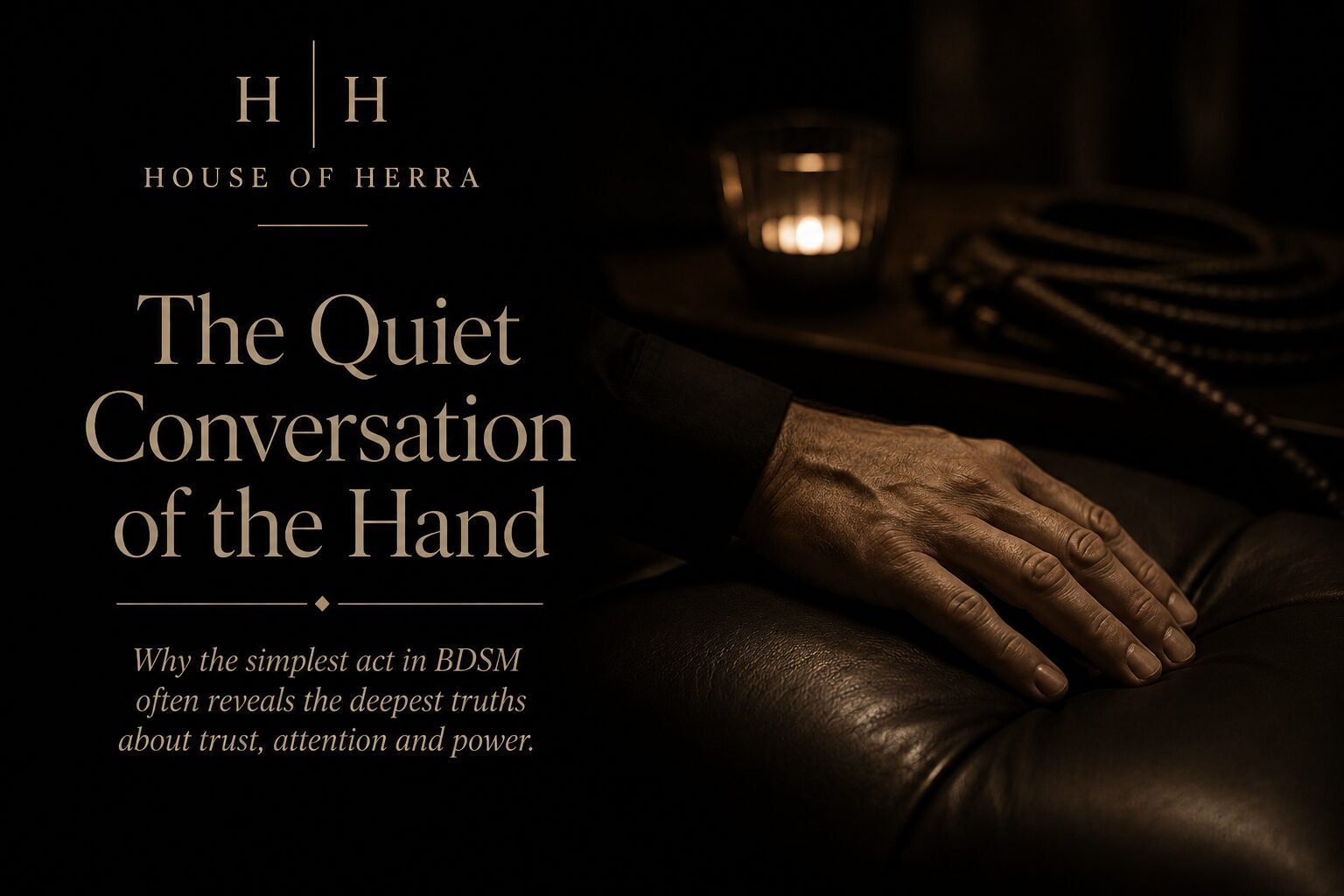
The Quiet Conversation of the Hand
Why the simplest act in BDSM often reveals the deepest truths about trust, attention and power.
There is something wonderfully unassuming about a hand.
The Conversation Beneath the Words
In a world where BDSM is often imagined through polished leather, intricate rope, gleaming steel and dramatic implements, an open palm can seem almost ordinary. It requires no specialist equipment, no elaborate preparation, no impressive collection of toys. Anyone can raise a hand.
Yet I have often found that the simplest tools demand the greatest skill.
A hand cannot hide behind craftsmanship. It offers no illusion that the equipment is doing the work. Every strike carries the personality of the person delivering it, their patience, restraint, confidence, hesitation and attentiveness. Likewise, every response reveals something about the person receiving it: their willingness to trust, to communicate, to surrender or to remain guarded.
Perhaps that is why erotic spanking has endured for so long. It is not because it is simple. It is because it is profoundly human.
At first glance, spanking appears to be about impact. One person strikes. Another receives. But the moment you reduce it to physical sensation, you miss the conversation taking place beneath it.
A good spanking is rarely a sequence of blows. It is an exchange of attention.
The Dominant listens with their eyes long before they listen with their ears. They notice breathing, posture, tension, anticipation and subtle shifts in expression. They discover whether their partner melts into the rhythm or braces against it. They learn where confidence becomes vulnerability and where excitement gives way to uncertainty.
Learning to Notice What Changes
The submissive, meanwhile, is engaged in an entirely different form of listening. They are learning whether each touch feels deliberate or careless. Whether the hand that strikes also knows how to comfort. Whether authority is being exercised with responsibility or merely performed for appearance.
Every impact asks the same quiet question.
Are you still with me?
That question matters far more than the force of the strike itself.
One of the misconceptions I encounter most often is that spanking is simply about pain. It is an understandable assumption. After all, pain is the most visible element. It leaves colour in the skin and draws involuntary reactions from the body. But pain, by itself, explains remarkably little. Context changes everything.
The same sensation delivered unexpectedly in everyday life would likely feel threatening or unwelcome. Delivered within a carefully negotiated scene, by someone we trust, the brain can interpret that identical sensation entirely differently. Anticipation, desire, emotional safety and mutual intention reshape the experience.
The body does not respond only to what happens. It responds to what the experience means.
That is why spanking occupies such an unusual place within BDSM. It can be playful, affectionate, disciplinary, ritualistic, intensely erotic or quietly meditative. The physical action remains recognisable, yet the emotional landscape shifts dramatically depending upon the relationship surrounding it.
Sometimes it is flirtation. Sometimes it is correction. Sometimes it is reassurance. Sometimes it becomes a language that requires remarkably few words.
Over time, I have come to believe that rhythm matters more than intensity.
A hurried scene often feels exactly that, hurried. Stronger impacts cannot compensate for a lack of presence. Conversely, a measured rhythm, delivered with patience and genuine attentiveness, allows something else to emerge.
The body begins to anticipate. The mind gradually stops analysing. Breathing slows. Awareness narrows.
Where Honesty Becomes Safety
For some submissives, this becomes the beginning of subspace, not because they have endured extraordinary pain, but because they have been given permission to stop carrying the constant weight of conscious thought. The repetition becomes almost hypnotic. The world shrinks until only two people remain, communicating through timing, sensation and trust.
It is tempting to imagine that the Dominant leads this dance alone. I have never believed that.
The submissive shapes every scene just as profoundly. Not through obedience alone, but through honesty.
A submissive who communicates openly about their limits, their fears and their desires creates the conditions in which genuine authority can exist. Without that honesty, a Dominant is left making assumptions. And assumptions are remarkably poor foundations for power.
This is one of the quiet paradoxes that outsiders often overlook.
Submission is not passive. Receiving well requires extraordinary awareness.
There is an art to recognising the difference between discomfort that feels exciting and discomfort that feels unsafe. There is courage in saying, "More," when you truly want more, and equal courage in saying, "Enough," when your body has reached its limit.
Neither response diminishes the dynamic. Both strengthen it.
Good communication does not interrupt intimacy. It creates it.
This becomes especially important when people first begin exploring spanking together. Beginners often search for techniques before they learn observation. They ask where to strike, how hard, how many times or with what implement.
These are reasonable questions. They are simply not the first questions.
The first question should always be far quieter. Who is the person standing in front of me?
No guide can answer that.
The Work of Being Understood
Experience certainly teaches practical considerations. The fleshy parts of the buttocks tolerate impact far better than vulnerable areas such as the spine, kidneys or tailbone. A gradual warm-up prepares both body and mind. Different positions alter not only physical sensation but also emotional tone, with an over-the-knee position creating an entirely different psychological atmosphere from standing against a wall or lying face down.
These details matter. They protect people.
But safety is never merely anatomical. It is relational.
A technically perfect scene delivered without empathy remains emotionally hollow.
A simple scene delivered with patience and genuine care can become unforgettable.
That distinction has become more meaningful to me with time.
When I was younger, I suspect I paid greater attention to technique than connection. I admired precision. I appreciated skill. There is undeniable satisfaction in developing competence with one's hands.
Yet competence alone is strangely forgettable. People rarely remember the exact number of strikes. They remember how they felt while they were receiving them. They remember whether they felt seen. Whether they felt understood. Whether they felt safe enough to surrender without fear of being misunderstood.
Those memories linger far longer than bruises ever do.
It is also worth acknowledging that spanking is not universally appealing, and it need not be.
Within BDSM there can be an unspoken temptation to treat every activity as though it represents another milestone to achieve or another experience to collect. Curiosity is healthy, but curiosity should never become obligation.
Some people discover that spanking awakens something deeply meaningful within them. Others discover it leaves them entirely unmoved. Neither response is more enlightened than the other.
The purpose of exploration is not to accumulate experiences. It is to understand ourselves a little better.
Perhaps that is why discussions about spanking sometimes drift towards questions of childhood, psychology or trauma. People naturally search for neat explanations. They want a single cause that makes desire understandable.
Human beings rarely cooperate with such simple narratives.
Our erotic landscapes are shaped by countless influences, personality, imagination, attachment, relationships, memory, emotion and experience. Sometimes we understand why something resonates with us. Sometimes we simply notice that it does. Not every meaningful desire requires solving like a puzzle. Sometimes it only asks to be approached with honesty and care.
What continues to fascinate me about spanking is not the impact itself. It is the responsibility carried by the hand that delivers it.
Power is often imagined as the freedom to act.
In healthy BDSM, I think power is better understood as the willingness to restrain oneself.
The hand could strike harder. It chooses not to.
The hand could ignore hesitation. It pauses instead.
The hand could demand. Instead, it pays attention.
That restraint is not weakness. It is discipline.
And perhaps that is the quiet lesson hidden within something as deceptively simple as an open palm.
Trust Is Built in the Response
The finest spanking scenes are never remembered because someone demonstrated impressive technique or remarkable endurance. They remain with us because, for a little while, two people became completely present with one another. The hand did more than create sensation. It communicated care, confidence and responsibility in equal measure.
When that happens, the marks that matter are rarely the ones left upon the skin.