
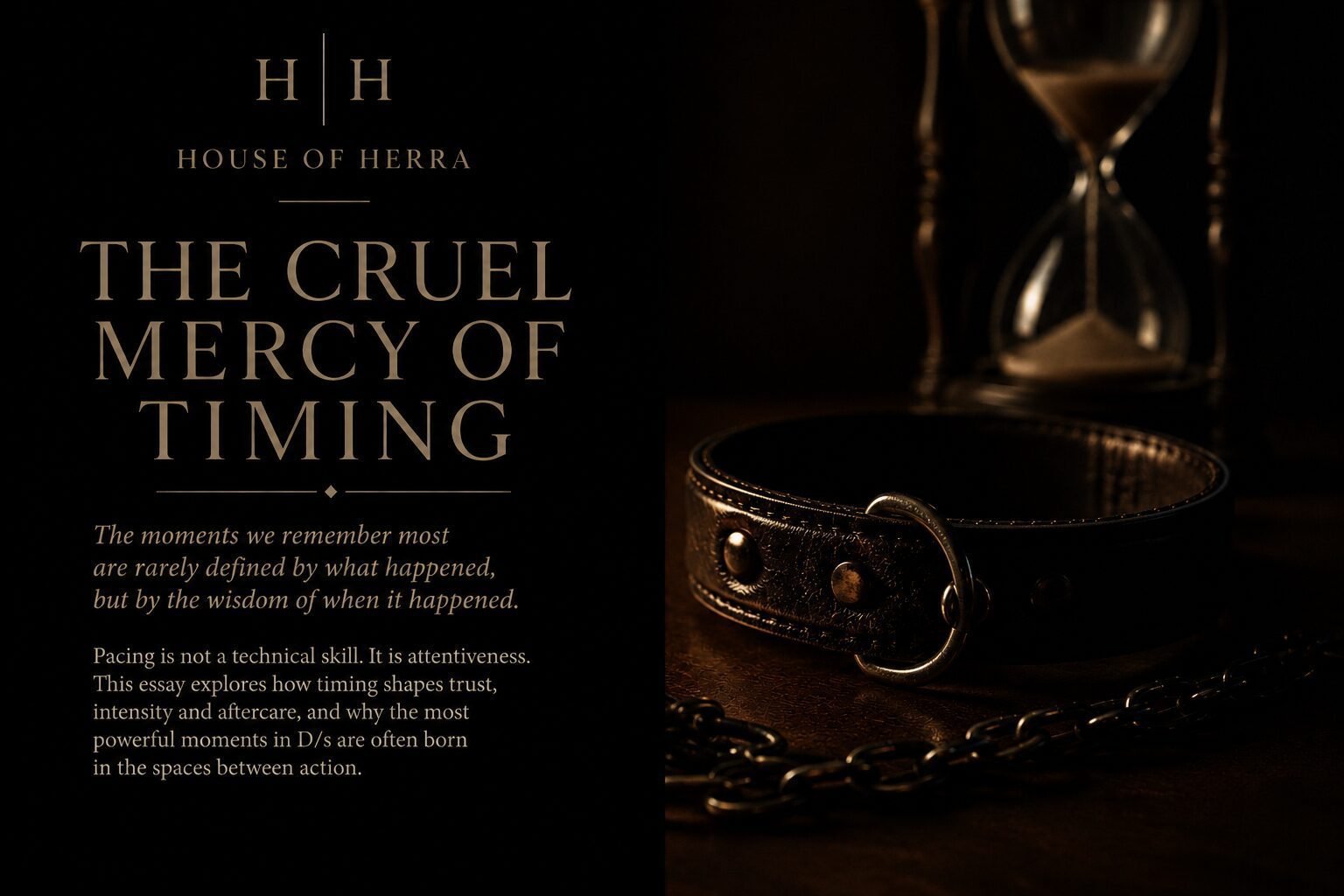
The Cruel Mercy of Timing
The moments we remember most are rarely defined by what happened, but by the wisdom of when it happened.
The Person Behind the Dynamic
There is something I've come to recognise over time that has little to do with implements, protocol or technical proficiency, yet it quietly shapes every memorable dynamic I've ever experienced. It is not strength. It is not confidence. It is not imagination.
It is timing.
That may seem an unremarkable observation at first. We often speak about communication, consent and trust, and rightly so. They are the foundations upon which every healthy dynamic rests. Yet hidden within each of them is something less frequently discussed: the ability to recognise when a moment is ready, and the discipline to wait until it is.
I have watched many new Dominants make the same mistake. If I am honest, I have made it myself. The eagerness to demonstrate competence can become its own kind of distraction. We rush,not always physically, but emotionally. We hurry from anticipation to action, from conversation to vulnerability, from stillness to intensity, believing that movement itself is evidence of leadership.
It rarely is.
With experience, I have come to believe that pacing is not a technical skill at all. It is a form of attentiveness. It asks far more of a Dominant than confidence ever could. It requires restraint when every instinct urges action. It demands observation when performance would be easier. Above all, it requires enough humility to accept that the scene unfolding before you matters more than the one you imagined beforehand.
Power, after all, is not measured by how quickly someone can take control. It is measured by how carefully they carry it.
There is an assumption that submission is built through intensity. The harder strike. The firmer command. The greater vulnerability. The deeper emotional exposure.
I no longer think that is true.
Desire Needs Room to Breathe
Intensity has its place, but it is rarely what people remember most. What lingers long after the bruises have faded is often something quieter. The feeling of being completely attended to. The unmistakable sense that another person was fully present, responding not to a script but to you.
People often describe memorable scenes in terms of what happened. I suspect what they are really remembering is how those moments made them feel. That feeling is born from pace.
One of the most powerful moments I have ever witnessed involved almost no action at all. A submissive crossed a crowded room, knelt without instruction, took her collar and offered it forward with both hands. Then she waited.
Nothing happened immediately. There was no dramatic command. No flourish. No urgency to fill the silence. For several long seconds, the room seemed to contract around that single moment of stillness.
It remains one of the most arresting displays of power I have seen.
Not because of what followed. Because of what did not. The silence had become part of the dynamic.
That is the peculiar generosity of anticipation. It asks nothing outwardly while transforming everything internally.
Waiting is rarely empty. The mind begins its own work long before the body follows. Imagination fills spaces that action never could. Every pause invites possibility. Every unanswered moment quietly asks, What comes next?
Submission often begins there, not with obedience, but with awareness. Awareness of another person's attention. Awareness that something meaningful is unfolding. Awareness that someone else is choosing each moment deliberately rather than carelessly.
It is tempting, particularly when nerves begin to surface, to keep moving. Many inexperienced Dominants mistake activity for authority. Silence becomes uncomfortable, so they speak. Uncertainty appears, so they accelerate. They transition quickly from one activity to another because movement disguises anxiety.
Yet confidence rarely feels hurried.
The people who seem most comfortable holding authority are often those who have no need to prove it through constant action. Their cadence slows the room rather than speeding it up. Their pauses feel intentional rather than uncertain.
Stillness, when chosen deliberately, communicates something words cannot.
It says, I am not afraid of this moment.
That confidence has little to do with appearances. It comes from trust, both in oneself and in the dynamic itself.
The same principle extends beyond physical play.
Trust unfolds at its own pace.
How Connection Changes Over Time
Every person arrives carrying different histories, different hesitations, different ways of protecting themselves. Some enter a dynamic eager to explore. Others arrive curious but cautious. Many carry experiences that have taught them to reveal themselves slowly.
There is a quiet violence in demanding vulnerability before it is ready.
Sometimes it happens unintentionally. We become so invested in where we hope the relationship might lead that we begin asking today's questions with tomorrow's expectations.
But intimacy does not respond well to deadlines. It grows much like confidence does, through countless small experiences that accumulate almost unnoticed until one day both people realise something fundamental has changed.
The timing mattered.
Not because waiting was inherently virtuous. Because readiness cannot be manufactured.
I have learned that observation is often more valuable than planning.
Every scene begins with intention, but the finest moments rarely unfold exactly as imagined. Breathing changes before words do. Eye contact lingers or retreats. Muscles tighten, then soften. Conversation shifts almost imperceptibly. Energy rises and falls throughout an encounter in ways no negotiation document could ever fully predict. The body tells stories long before language catches up.
A Dominant who becomes consumed by executing a plan risks missing those stories entirely.
Listening, in this sense, is not passive. It is active attention. It is recognising that authority does not remove collaboration. It simply changes its form.
The submissive continues communicating throughout the scene, often without speaking at all. The question is whether anyone is listening.
Some of the scenes I remember most ended somewhere entirely different from where they began. Occasionally they became gentler than I had anticipated because reassurance proved more important than discipline. On other occasions, trust deepened so naturally that the emotional landscape invited far greater intensity than either of us had expected.
Neither outcome represented failure. Both represented responsiveness.
Flexibility is not the opposite of control. It is one of its highest expressions.
We often think of pacing only in relation to what happens during a scene, but its influence extends far beyond the final command or the last strike.
The nervous system remembers journeys.
The Courage of Remaining Honest
A scene that climbs too sharply can leave someone emotionally disoriented once the intensity subsides. The body eventually relinquishes adrenaline, endorphins and heightened awareness. What follows can feel abrupt, even lonely, if no care has been taken to guide someone gently back towards equilibrium.
Aftercare begins long before aftercare. It begins with every decision that prevented unnecessary overwhelm in the first place. Good pacing creates smoother landings because it never forgets that people must eventually return to themselves.
Perhaps this is why timing has come to feel less like a practical skill and more like an ethical one.
Anyone can create intensity. Volume is easy. Pain is accessible. Authority can be performed. Fear is uncomplicated.
But deliberate pacing reveals something altogether different.
It reveals care. Not sentimental care, nor cautious hesitation, but the kind of care that says, This moment deserves my full attention. I will not consume it simply because I have the power to do so.
There is generosity in restraint. There is respect in waiting. There is compassion in recognising that another person's nervous system is not an obstacle to overcome but something temporarily entrusted to your hands. That, to me, is where stewardship begins.
Over time, I have become less interested in displays of dominance and more interested in their consequences.
Anyone can impress for an evening. Far fewer people leave someone feeling genuinely understood.
Those experiences rarely depend upon complexity. They are built from countless ordinary decisions made with extraordinary attentiveness. A pause before giving an instruction. A slower breath instead of another strike. A question postponed because trust has not yet reached the place where the answer could be offered freely.
None of those moments would appear dramatic to an observer. Yet they often become the moments people carry home.
When I think back over the scenes that have stayed with me, not simply as memories, but as experiences that quietly altered the people involved, I find remarkably little spectacle.
Instead, I remember patience. I remember watching anticipation become connection.
I remember silence becoming communication.
What We Choose Together
I remember discovering that authority sometimes looks less like moving the moment forward than protecting it from moving too quickly.
Perhaps that is the quiet mercy of timing.
It reminds us that power is never simply about deciding what happens.
It is about recognising when the next moment has truly arrived.
And sometimes, the deepest act of dominance is not the command that follows.
It is the pause that makes it meaningful.