
Negotiation Is Where Trust Learns to Speak
The Foundation Beneath the Dynamic
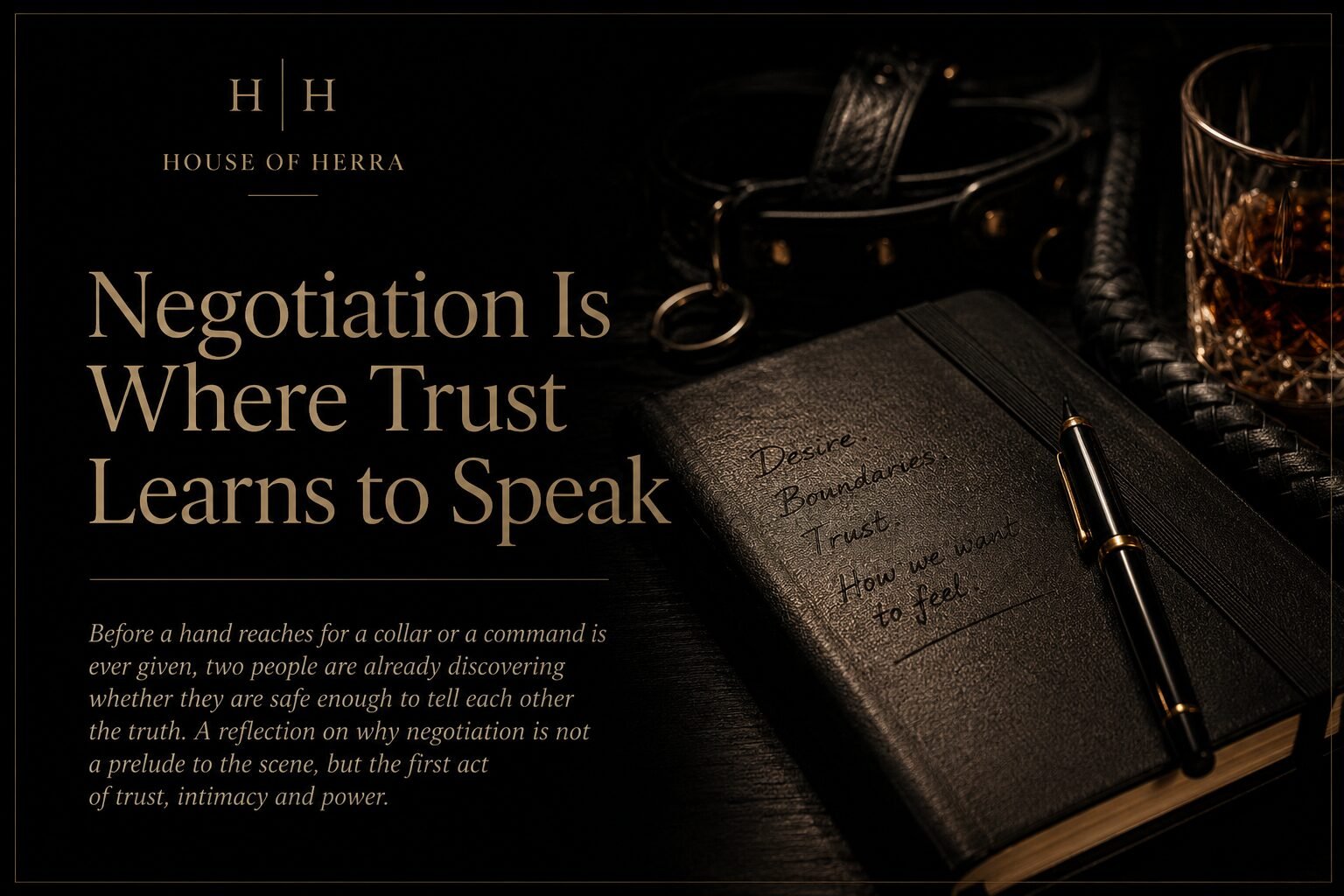
Before a hand reaches for a collar or a command is ever given, two people are already discovering whether they are safe enough to tell each other the truth.
There is a moment that rarely appears in photographs of BDSM. No rope has been tied. No collar has been fastened. Nobody is kneeling. There is no crack of leather or quiet gasp that announces the beginning of a scene.
Instead, two people sit opposite one another with coffee, or perhaps a drink between them. The conversation moves slowly. Questions are asked without urgency. Answers arrive with pauses attached to them. Every now and then, one person hesitates, searching for words that have perhaps never been spoken aloud before.
The First Scene Begins With Conversation
I've come to believe that this is where the first scene begins.
Dominance Begins With Attention
It is tempting to think that dominance starts with authority. Popular culture has taught us to recognise it in commands, posture and confidence. Yet the longer I have spent within this community, the more convinced I have become that genuine dominance begins somewhere much quieter. It begins with attention.
Not the attention that waits impatiently for its turn to speak, but the kind that listens with genuine curiosity. The kind that notices not only what is said but how it is said. A fantasy mentioned almost apologetically. A nervous smile that appears when desire finally reaches the surface. The brief silence before someone admits something they have carried privately for years. Those moments are rarely dramatic, but they are deeply revealing.
What I am listening for is not confidence. Confidence can be rehearsed. People arrive carrying versions of themselves they believe will be attractive, experienced or acceptable. They often know how they think they ought to answer questions about kink.
Honesty sounds different. Honesty hesitates. Honesty sometimes changes its mind halfway through a sentence. Honesty occasionally admits, "I don't actually know." Those answers have always interested me far more than polished certainty.
Where Trust Begins
There is a particular intimacy in watching someone slowly decide that they are safe enough to stop performing. It is easy to underestimate how vulnerable negotiation can feel, especially for someone who is still discovering their own desires. Speaking a fantasy aloud often makes it feel more real than imagining it ever did. The simple act of describing a longing to another person can feel like placing a fragile part of yourself into unfamiliar hands. That deserves care.
Perhaps this is why I have never been comfortable thinking of negotiation as merely a practical exercise. Certainly, limits matter. Safewords matter. Medical considerations, boundaries and expectations all deserve thoughtful discussion. None of these things are optional.
Questions That Reveal More Than Preferences
But neither are they the whole conversation.
If negotiation becomes nothing more than a checklist of permitted activities, we risk overlooking the person sitting behind the answers.
Two people may both enjoy impact play, yet be searching for entirely different experiences. One may crave intensity. Another may seek comfort. One may be exploring fear, another reassurance. One may long for challenge, while the other simply wants permission to let go.
The activity tells us remarkably little on its own. The feeling tells us almost everything.
That is why I have gradually stopped asking only what someone wants to do. I find myself becoming far more interested in asking how they hope to feel. The answers often reveal far more than the original question ever could.
Someone who says they enjoy the slow warmth that spreads beneath a flogger has already told me something about rhythm and patience. Someone who admits they love anticipation more than the strike itself has revealed that expectation carries more emotional weight than sensation. Another may speak less about pain altogether and more about finally feeling seen, trusted or allowed to surrender responsibility for a little while.
None of those answers are really about implements. They are about people.
This is where negotiation quietly becomes something far richer than administration. It becomes an exploration of emotional landscapes rather than physical activities. We stop discussing what happens to bodies and begin understanding what matters to hearts and minds.
Experience has also taught me that some of the most important conversations happen without words at all.
Sometimes someone says yes while every other part of them whispers uncertainty. Their shoulders rise almost imperceptibly. Their breathing changes. Their smile arrives a fraction too late. Eye contact disappears.
The words themselves may sound reassuring, yet something beneath them asks for more time.
When Hesitation Needs Space
I have learned never to ignore those moments.
Consent as an Ongoing Conversation
Not because uncertainty necessarily means refusal, but because uncertainty deserves curiosity before it deserves agreement.
There is an understandable temptation within any negotiation to reach a conclusion. Decisions feel satisfying. Clarity feels efficient. Yet people are rarely as neatly organised as the conversations we try to have about them.
Many fantasies exist first as feelings rather than fully formed ideas. Someone may know they are drawn towards something without yet understanding why. They may struggle to separate genuine desire from expectation, curiosity from commitment, fantasy from lived experience.
That uncertainty is not a problem to solve. It is simply part of being human.
The healthiest negotiations I have witnessed have always allowed space for that uncertainty to exist without embarrassment. There is tremendous safety in hearing someone say, "We don't need to decide today."
Patience is often mistaken for passivity. In truth, patience can be one of the most active expressions of care available to us.
If someone feels safer agreeing than disappointing us, then the conversation has already drifted away from honesty. No scene, however technically impressive, can repair a foundation built upon quiet reluctance.
Trust cannot grow where performance is rewarded more than truth. Of course, this responsibility does not belong only to the Dominant.
What Responsibility Requires
One of the quieter myths surrounding BDSM is that negotiation is primarily an interview conducted by the Dominant. The submissive answers questions while the Dominant evaluates compatibility.
Healthy dynamics have never felt like that to me. Power exchange does not begin by removing equality from conversation. It begins by strengthening it.
A submissive deserves to understand the person they may choose to trust. They deserve to know whether my dominance tends towards gentle structure or firm challenge. Whether I naturally move slowly or intensely. Whether I communicate frequently during a scene or prefer long stretches of silence. Whether aftercare is something I view as an obligation or as an extension of the relationship itself.
Negotiation is not about one person becoming known.
Trust Is Built Before Any Implement Is Lifted
It is about two people becoming understandable to one another.
Compatibility is rarely built upon identical interests. It is built upon compatible ways of communicating.
Over time, I have become increasingly convinced that negotiation reveals the shape of a relationship long before the relationship itself has properly begun.
It tells us how someone approaches vulnerability. How they respond when expectations change. Whether they ask questions with genuine curiosity or merely wait for reassuring answers. Whether they become defensive when boundaries appear. Whether they treat honesty as something to welcome or something to overcome.
These small moments often predict far more than shared kinks ever could. The scene itself may last an hour. The habits established during negotiation often last for years.
Perhaps that is why I find it difficult to separate negotiation from the scene that follows. By the time the first command is spoken, something important has already taken place. Anticipation has begun to settle between two people. Trust has started taking shape. Each careful question has quietly tightened an invisible thread long before any rope ever touches the skin.
The implements, the protocol and the rituals all have their place. They can be beautiful expressions of power, vulnerability and care. Yet they are not the source of those things. They simply reveal what already exists.
The real work begins much earlier, in a conversation where two people slowly discover whether they can entrust one another with something infinitely more valuable than a fantasy.
The truth.
The Practice Beneath the Principle
And when that truth is offered freely, listened to carefully and held with genuine respect, everything that follows rests upon something stronger than technique or experience.
It rests upon two people choosing honesty before power.
In my experience, that has always been where the finest scenes truly begin.