
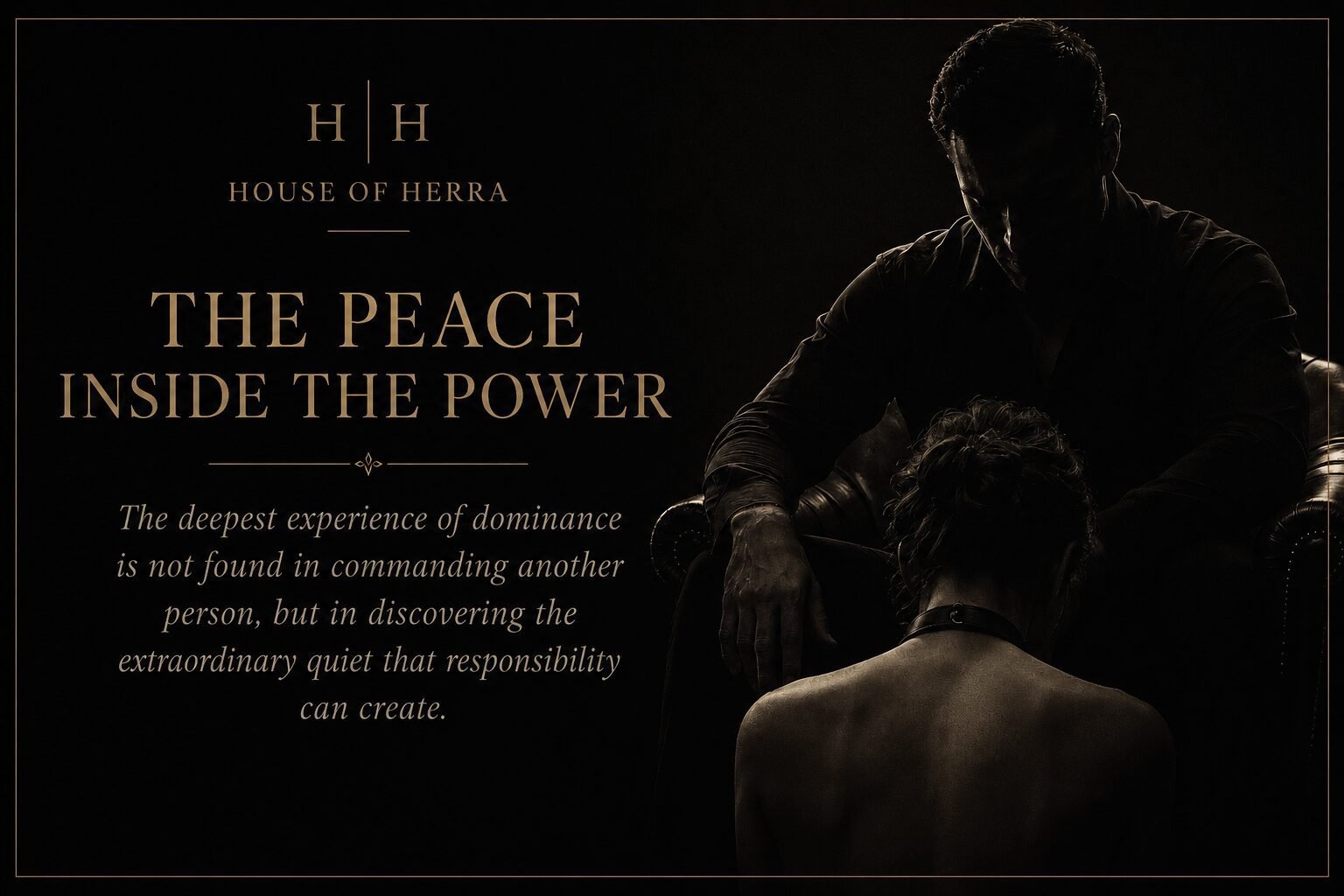
The Peace Inside the Power
The deepest experience of dominance is not found in commanding another person, but in discovering the extraordinary quiet that responsibility can create.
The Quiet Inside Dominance
There is a kind of silence I have only ever found in one place.
Not in an empty room. Not in meditation. Not during long walks or the rare evenings when life finally loosens its grip on my thoughts. Those moments have their own value, but they have never quite reached the place I am talking about.
The silence I mean exists in the middle of intensity.
It arrives unexpectedly, almost unnoticed, while everything around me appears to be moving. A scene is unfolding. There is conversation without words, sensation, anticipation, adjustment. From the outside, nothing about the moment looks still.
Yet somewhere beneath it all, my mind becomes completely quiet. Not blank. Not detached. Simply present.
It took me years to recognise how unusual that feeling was because conversations within BDSM rarely linger there. We speak, quite rightly, about subspace. We talk about surrender, altered states, emotional release and the profound calm many submissives discover when they no longer need to carry responsibility for a while. Those experiences deserve the attention they receive because they can reshape how someone understands themselves.
But I have often wondered why we speak so little about what can happen inside the Dominant. Not because the experiences are identical. They are not. Nor because every Dominant will experience them in the same way. Rather because there is another form of stillness that deserves to be understood, not as something mystical or extraordinary, but as one of the quieter gifts that this way of relating can offer.
Beyond Domspace
People sometimes describe that experience as Domspace. I understand why. Yet, if I am honest, the one occasion I believe I truly entered that state left me feeling less peaceful than unsettled. There was a sense of distance from myself that I had not expected. It carried its own intensity, but not the clarity I had come to value.
The peace I have returned to time and again feels altogether different. It is born not from altered consciousness, but from complete attention. Perhaps that is what surprises me most.
Outside a scene, my thoughts behave much like everyone else's. They leap ahead to tomorrow's obligations, wander backwards through conversations I wish I had handled differently, drift towards unfinished work, unanswered messages and the countless small concerns that quietly accumulate through ordinary life.
Modern life has become remarkably efficient at fragmenting our attention. We divide ourselves between screens, responsibilities and constant interruption until presence itself begins to feel like a luxury rather than our natural state.
I do not think most of us realise how rarely we inhabit the moment we are actually living.
Presence as a Form of Responsibility
Then a scene begins.
Almost imperceptibly, everything unnecessary falls away. My attention settles entirely on the person before me. The rhythm of their breathing. The subtle changes in muscle tension. The way their shoulders soften when trust deepens. The hesitation that appears for only a fraction of a second before disappearing again. The difference between nervous anticipation and genuine distress. The difference between silence that signals contentment and silence that asks a question.
None of these observations are dramatic in isolation. Yet together they form the language through which a scene truly unfolds. That language cannot be understood while distracted. It cannot be read through assumptions. It demands presence.
The Willingness to Pay Attention
I have come to believe that this, more than authority or confidence, is one of the defining qualities of responsible dominance. Not the ability to command. The willingness to pay attention.
There is a temptation, particularly from outside the community, to imagine dominance as an exercise in imposing control. Popular culture has encouraged that misunderstanding for decades. It often portrays the Dominant as someone consumed by certainty, issuing instructions with unwavering confidence while remaining emotionally untouched by what unfolds. My experience has been almost the opposite.
The more seriously I have taken this role, the less interested I have become in projecting certainty. Instead, I have become increasingly fascinated by observation.
Dominance, at least as I have learned to practise it, is not about becoming larger than another person. It is about becoming more available to them. That availability requires a quality of attention that is surprisingly difficult to sustain anywhere else. Every gesture matters. Every hesitation deserves curiosity. Every breath carries information.
Power, when held responsibly, sharpens perception rather than diminishing it. Perhaps that is why the mind grows so quiet. There is simply no room for anything else.
When Responsibility Creates Calm
What I have found particularly interesting is that responsibility itself seems to create the calm. From a distance, that sounds almost contradictory.
Responsibility is usually associated with pressure. The greater the responsibility, the greater the weight we imagine someone must carry. We expect tension, vigilance and exhaustion. Yet within a well-negotiated scene, responsibility often has the opposite effect. Because priorities become beautifully uncomplicated. Keep them safe. Keep them seen. Keep listening. Remain connected.
Everything else can wait. The inbox will still exist tomorrow. The bills will still need paying. The uncertainty of the future has not disappeared. But for this moment, another human being has entrusted me with something profoundly precious. Their vulnerability. Their confidence. Their willingness to place themselves in my care.
That trust simplifies the landscape of the mind. Not because the responsibility is small. Because it is so important that everything less important naturally fades into the background.
Power Without Presence Is Choreography
I sometimes wonder whether this is one of the least understood aspects of BDSM.
People often imagine the practices themselves to be the source of meaning. The implements, the rituals, the titles, the visible expressions of power exchange. Those things certainly have their place. They can enrich a relationship and deepen shared experiences. But remove the presence beneath them, and they become little more than choreography. A flogger does not create intimacy. A collar does not create devotion. Authority is not established by giving instructions.
The experience becomes meaningful because two people choose to inhabit the same moment with extraordinary attentiveness. Everything else is secondary.
What Dominance Taught Me About Presence
In many ways, BDSM has taught me less about power than it has about presence.
Long before I understood that distinction, I believed I was learning how to lead. Perhaps I was.
But somewhere along the way I realised I was also learning how to listen with greater precision, how to notice without immediately interpreting, and how to remain emotionally available even while carrying responsibility.
Those lessons have followed me far beyond the play space. I listen differently in ordinary conversations now. I notice when people say one thing while their posture quietly reveals another. I have become slower to assume and quicker to ask. Presence, it turns out, is not a skill reserved for scenes.
It is a way of meeting another person. That may be one of the quiet ironies of this life.
Many people arrive in BDSM searching for excitement, exploration or intensity. Those are understandable motivations, and there is nothing inherently wrong with them. Yet some of the most valuable things I have found here have been remarkably gentle. Patience. Attention. Stillness. The confidence that grows from observation rather than performance. The peace that emerges when responsibility is accepted willingly instead of resisted.
I would never claim that BDSM is an escape from ordinary life. If anything, it asks more of us than ordinary life often does. It asks us to communicate with greater honesty. To observe more carefully. To take responsibility more seriously. To become more intentional in the way we hold another person's trust.
Perhaps that is why the quiet feels so rare. It is not gifted to us by BDSM itself. It is earned through the discipline of becoming fully present.
The Peace Inside the Power
For all the intensity this world can contain, for all the conversations about power, protocol and control, the moments I find myself returning to are seldom the loud ones. They are the moments when the rest of the world disappears without effort. When another person's wellbeing becomes the only thing that matters. When responsibility no longer feels heavy because it has become purposeful.
And when, in the middle of everything that appears so intense from the outside, I discover something unexpectedly simple.
A kind of peace that can only exist when nothing of myself is elsewhere.